Our newly built "Learning & Culture Workshop" was officially opened in July 2024 and offers state-of-the-art learning and teaching opportunities on three levels with over 2,000 square meters of usable space in addition to a large auditorium with a theater hall. Traditional forms of teaching are broken up here in order to be able to work with our pupils in a much more differentiated way than before.
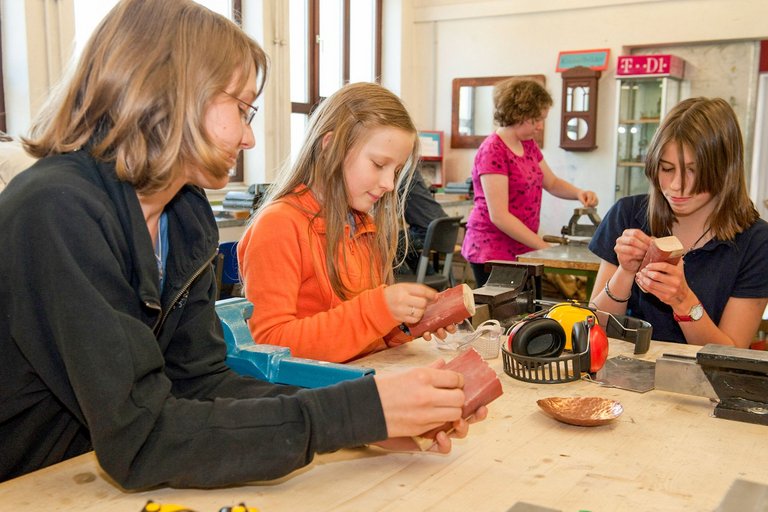
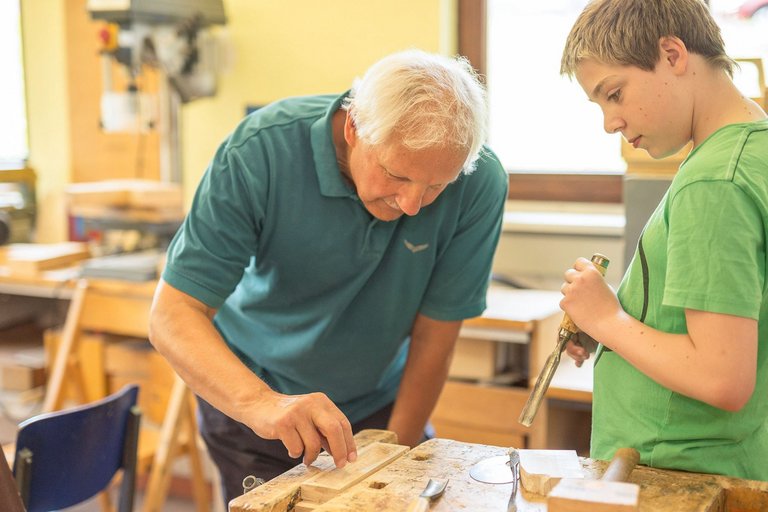
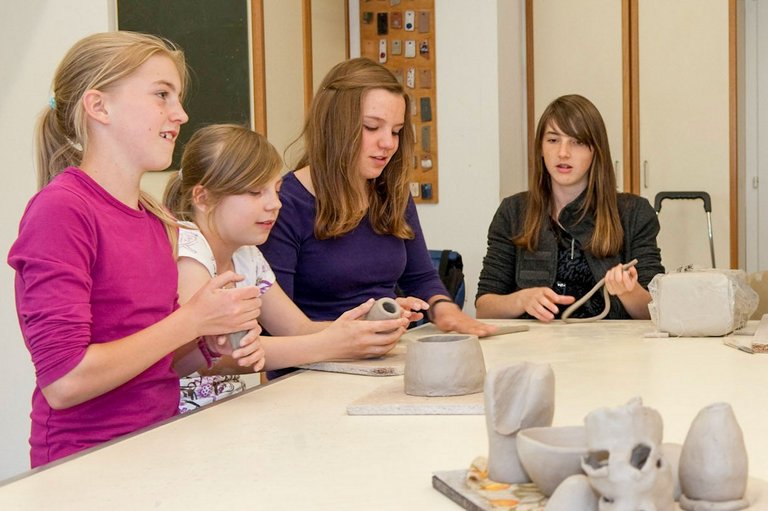
The lower entrance level houses our numerous workshops, such as those for metal, wood and clay processing, where our students can develop or expand their practical skills. In our school subject "Craft and Design", the children in the lower school can give free rein to their creativity here.
The spacious and modern rooms for creative and artistic activities are located on the ground floor. Art lessons take place here in two studio-like, light-flooded rooms that give creativity plenty of scope for development. The dark room for painting lessons is a real novelty: Here, art can be created and exhibited in the special field of tension between light and shadow.
There is also an additional "second kitchen" on the first floor level for cooking lessons, among other things, as well as a modern cafeteria with additional seating elements in the outdoor area.
A jewel of our "learning & culture workshop" is the assembly hall with a large theater stage and state-of-the-art technology, as well as the associated changing rooms and a special piano room.
The one-and-a-half storey, 93 m² classrooms for our 5th graders are located in the upper area, as well as the anteroom, also known as the "learning landscape", as innovative learning concepts are implemented here.
The programme in the auditorium of our "Learning & Culture Workshop" is co-planned and co-organized by our student groups.
Theater, music & culture at school
Theater workhas played an important role at the Schloss-Schule for decades. Between 60 and 80 students are regularly involved in the three theater groups, which are supervised by teachers with many years of theater experience both inside and outside of school and some older students.
Here you can find our theater performances.
The lower and middle school groups usually work on plays from the field of children's and youth theater, while the upper school group presents scenic collages or full-length plays. In principle, all interested parties are welcome, regardless of their acting talents - working in the group and on the role often reveals skills that lie undiscovered in everyday life both inside and outside of school.
The groups meet at least once a week in the theater hall to practice, tinker and organize; in addition to developing physical and vocal expression and roles, texts are rewritten or created, and technology, props and stage design are discussed and designed. In this area in particular, there is frequent cooperation at the school between pupils of different ages, with colleagues from the fields of music, visual arts and technology, with parents, with extracurricular institutions and organizations.
Exchanges with other schools also play an important role and the Schloss-Schule's theater groups regularly take part in school theater days, where children and young people meet with students from other high schools and secondary schools.
In addition, our school offers the school subject "Literature and Theater" for students in grades 11 and 12, which is taught for two years and can be chosen as a subject for the Abitur examination. The main focus here is on theater pedagogy and theater theory.
The music department at the Schloss-Schule Kirchberg grammar school is divided into a classroom section and a club section.
In accordance with the guidelines of the state of Baden-Württemberg, music is offered as a subject from year 5 to 12. Since 1988, music has also been offered almost continuously as an Abitur subject at the school, initially as an advanced course and now as a special subject. In this way, we aim to comprehensively promote special artistic talents - as in the subject of fine arts.
As an alternative to music lessons at school, Year 5 and 6 have had the opportunity to take part in the wind class for several years. Here, the pupils receive small group lessons in their chosen instrument; at the same time, they experience the joy of making music together at school in the overall rehearsal of the wind class and learn to fit into a large community with their own important and indispensable role.
The AG area of our boarding school is diverse: the offer ranges from the school choir, in which pupils from Year 7 and teachers sing together, to an instrumental playing group and the clarinet AG to the school's big band. All of the clubs, as well as the wind class, enrich the school's musical life, such as the regular school and Christmas concerts.
There areopportunities for interested pupilsto practise in the respective classrooms (for melodic instruments) as well as in the two music rooms (for piano and percussion). The Schloss-Schule's theater hall has a grand piano and a complete set of percussion instruments. The 96 square meter music and multimedia room - with acoustic ceiling, Dolby Surround 7.1. system and full-size video screen - has an acoustic (Grotrian-Steinweg) and a digital piano. A very good Steinway grand piano (model A) is available for particularly talented pianists.

Craft & design at the Schloss-Schule
Living, learning, working - our Schloss-Schul motto already clearly shows that manual skills and technical understanding are a focal point in the development of our pupils.
For us and our boarding school, "working" means becoming familiar with a wide variety of materials and working techniques in our own workshops.
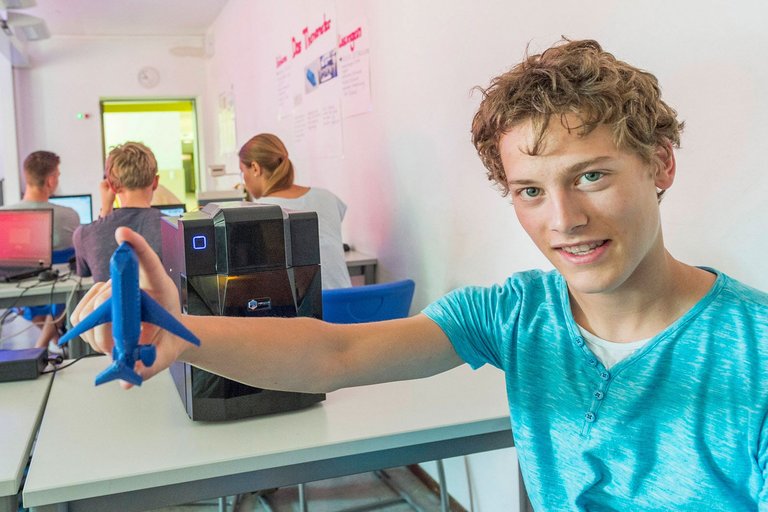
In NwT (science and technology), for example, pupils at our school work on robotics, CAD programming, circuit board construction, bridge building and astronomy in the individual class levels.
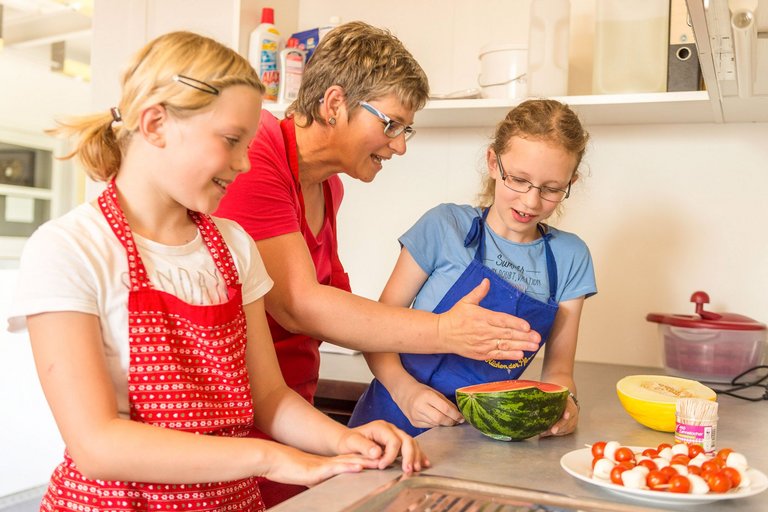
In technology, our school focuses on woodworking and metalworking, as well as pottery, cooking and sewing.
Overall, our Schloss-Schule offers a wide range of activities in the area of "Craft & Technology" that cater to the individual abilities of each pupil, thereby broadening their knowledge spectrum and giving them a sense of achievement.