Preparing for an increasingly digitalized world
We live in the information age; almost all processes in our daily lives are equipped with information-processing, computer-based technology modules. In many areas, Germany's economic success is based on high-quality technical implementations and the use of IT infrastructures. It therefore seems more than sensible that children and young people should also be prepared for this and the subsequent age of an increasingly digitalized world in an age-appropriate manner. It is not just the correct use and consumption of media that is an important part of school education, but also IT lessons that promote understanding in detail.
According to the Baden-Württemberg curriculum
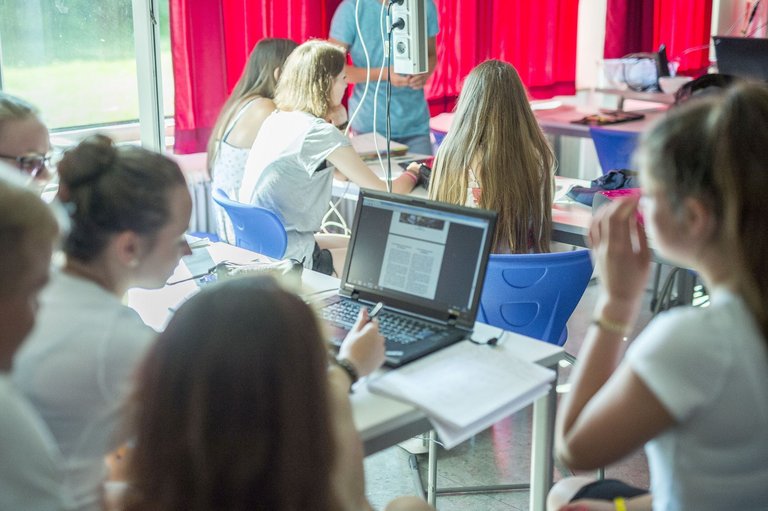
The state of Baden-Württemberg offers the following options by means of educational plans: In year 7, computer science is a compulsory one-hour subject at all grammar schools. After that, children and young people can choose whether they want to take the profile subject IMP (computer science, mathematics and physics) with a corresponding specialization, or another profile subject that does not include IT content. In year 10, students can then attend a preparatory course in computer science , which can then be continued in the course level as a basic or advanced subject up to the Abitur and even an Abitur examination. Nevertheless, it is also possible to obtain a general university entrance qualification, even though computer science was only a subject in year 7.
In view of this, we have developed our own computer science concept at the Schloss-Schule, which, in addition to the compulsory lessons, offers all students from grade 8 onwards an additional course in computer science, which can then be chosen each year up to and including grade 10 .
The Schloss-Schule's own concept
Computer science lessons in year 8 can be divided into three main subject areas:
- Data and coding
In this area, we deal with binary codes (conversion of binary numbers to decimal numbers, addition and subtraction), error-recognizing codes (ISBN, EAN, check digits), error-correcting codes (parity bit, Hamming code, XOR linking). - Algorithms
In this area, children and young people learn programming with the BOB3 board under supervision. This involves, for example, understanding and applying the principle of programming, the meaning of programming syntax (loops, if - else - queries, switch - case, ...), how to control the robot LEDs (flashing light and changing the colors of the LEDs), how to make LEDs light up depending on conditions (e.g. true/false) and how to control and evaluate sensors (e.g. IR sensor, temperature sensor). - Computers and networks
This section looks at the structure and simulation of simple networks, communication between computers (addressing, structure of IP4 and MAC addresses, packet orientation, protocols) as well as the client/server principle and the function of servers. They will also practise accessing a website (structure of an Internet address, DNS server as a telephone directory for the Internet) and create their own simple websites.
In year 9, these topic blocks are expanded and supplemented...
...by the areas of "Information society and data security" and "Data and coding". Here, students learn about the Vigenère method and how this encryption method can be attacked or cracked and what security is based on when encrypting data. The problems of data loss and data recovery options are discussed and students develop their own strategies for preventing data loss at home. Data compression methods are used to show students why they are useful and why they can lead to a loss of information and therefore quality.
The overall concept is then rounded off in year 10...
...with the subject areas "Algorithms" and "Computers and Networks". Here, the knowledge from grade 8 is refreshed and the logical operators that are important for computer science are introduced and explained. The effectiveness of algorithms is examined in practice and the theoretical foundations and background of programming are further deepened.