In conversation with Dr. Lorenz Granrath - July 2025
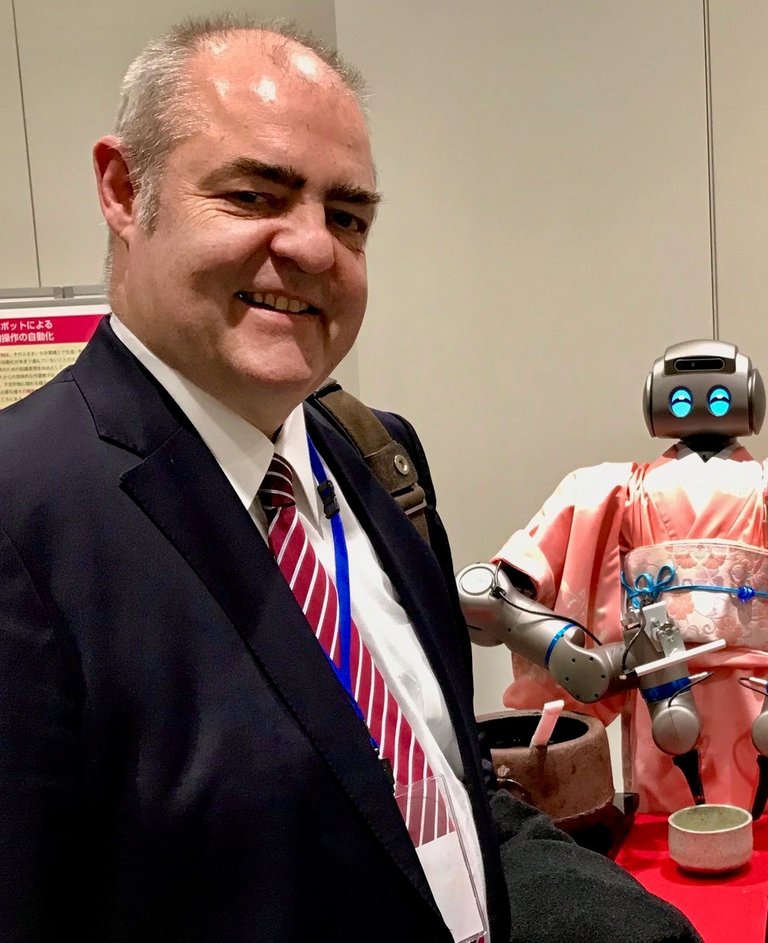
Lorenz lives with his family in Japan and has lived there for over 20 years. He is passionate about building a network and nurturing the potential that lies within it. He is extremely successful at this. He has worked for renowned institutions and organizations such as the Fraunhofer Gesellschaft. He is grateful for the fact that he came to Japan and that the right opportunities have always opened up in his life.
What is the first thing that spontaneously comes to mind when you think of your time at the Schloss-Schule?
The first thing I think of is that I was away from home, away from my parents and on my own. It was really different. It was also a new experience to be in a room with two other students.
The school was much smaller and we therefore had much more contact with the teachers. I was not used to that. We were also treated as equals as students and spent more time together with the teachers. We ate together and also lived on campus with some of the teachers. I experienced community much more intensively here. I spent a total of two years at the Schloss-Schule from 1979 to 1981.
Would you like to tell us something about your time at school before you came to the SK?
I originally come from near Düsseldorf. I come from a small town and went to elementary school here. After that I went to grammar school, which was about 1/2 hour's drive from home. As my performance in the upper school was no longer so good, the idea of attending a boarding school came up. We looked at a few boarding schools and Kirchberg convinced us. My mother had already been to a boarding school. Kirchberg was rather small in comparison, the classes weren't big - that was very good for me. My performance was also better straight away and I voluntarily repeated year 12. That was great for me.
What has changed in Kirchberg?
The most important change for me was the significant improvement in my grades thanks to the different structure at school. Learning in the small classes was much more intensive, so I didn't have to do much outside of lessons.
What did you find formative? What values, life lessons and other things still stay with you today?
The idea of community was very formative. It was a matter of course that we supported each other and were there for each other. It also meant that everyone met as equals and that you could help shape many things. Everyone was treated equally and this is a principle that I have retained to this day.
What happened after the SK?
After graduating from high school, I first did an internship. I then decided to study mechanical engineering in Karlsruhe. From the third semester onwards, I switched to industrial engineering. I was already working as a research assistant at the Fraunhofer Institute during my undergraduate studies. This delayed my intermediate diploma somewhat, but the job was necessary because I had to finance my studies myself. My parents were unable to support me at that time. I finished in 1990 because I simply needed more time due to the part-time jobs I had to do. After completing my studies, I did my doctorate in St. Gallen. Here, too, I financed myself. I got a scholarship and was able to go to Japan, where I was at Tokyo University from 1992 to 1993. I was very fascinated by life in Japan. My dream was to return there.
My entire time as a student was characterized by my work at the Fraunhofer Institute.
I then started my career in 1994 in Berlin on a trainee program at Commerzbank, then moved to ABB Heidelberg in 1995 and then to the GMD - Research Center for Information Technology in Bonn in 1997. I was still in contact with Fraunhofer and so I was able to go to Japan for Fraunhofer in 2001 and set up the Fraunhofer Representative Office Japan. Here I built up a network of research partners - in 2012 we were able to establish a Fraunhofer Project Center for MEMS (Mechanical Electrical Microsystems) at Tohoku University. Even more important, however, were the research contracts from all the well-known companies in Japanese industry, which I did very successfully until 2013. Unfortunately, my salary had become too high in the meantime, as I had a profit-sharing payment and we parted with a good severance package, which then allowed me to work for the Japanese research institution AIST (National Institute for Advanced Industrial Science and Technology) from 2014 and to represent various companies and start-ups.
From 2021, I was then a project professor at Tohoku University for a year and have been advising various companies and institutions ever since.
Unfortunately, the pension concept in Japan is completely different from that in Germany, so it is also normal to work into old age. The pension payments are simply far too low to live on. That's why I'm not ready to retire yet. Today, I'm mainly involved in production digitization, supporting companies in building networks so that they can exchange ideas and develop further. And, of course, I'm also involved in the field of AI and support them with my expertise and experience.
What stories and anecdotes do you remember from your school days?
I can well remember that we sometimes climbed out of the window at night and then went to the pub. Sometimes we would meet teachers and educators there and have an open conversation in which the teachers would tell us what was on their minds and help us to see things through a different lens.
What are you grateful for?
I am extremely grateful for my large network. And also that it worked out with Japan. That was really my big wish and it came true! I am also very grateful for everything I was able to experience and how things turned out well again, even after professional problems, for example.
Looking back on your time at school, what would you do differently today?
I wouldn't want to do anything differently.
Would you like to support the school and the current students?
If so, what could you imagine doing?
Since I live in Japan, I could imagine online lectures about living and working in Japan, for example, or of course on the topic of AI or digitalization.
What else would you like to share?
I am happy that I am still in good contact with some of my school colleagues from the Schloss-Schule and that I am still friends even after this long time and the great distance.