In conversation with Prof. Tilo Staudenrausch - April 2024
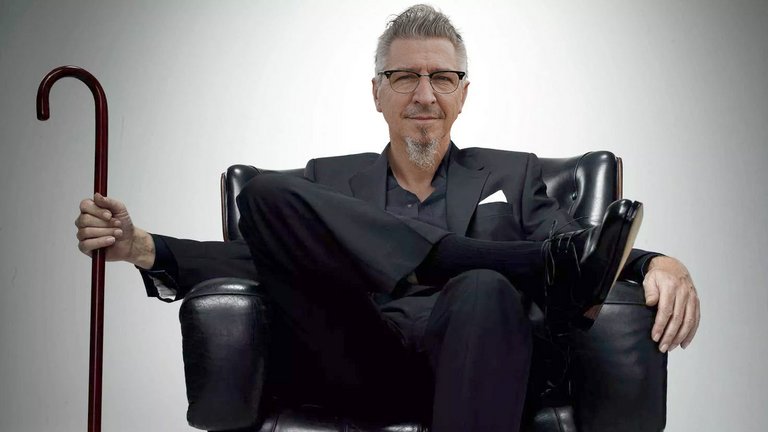
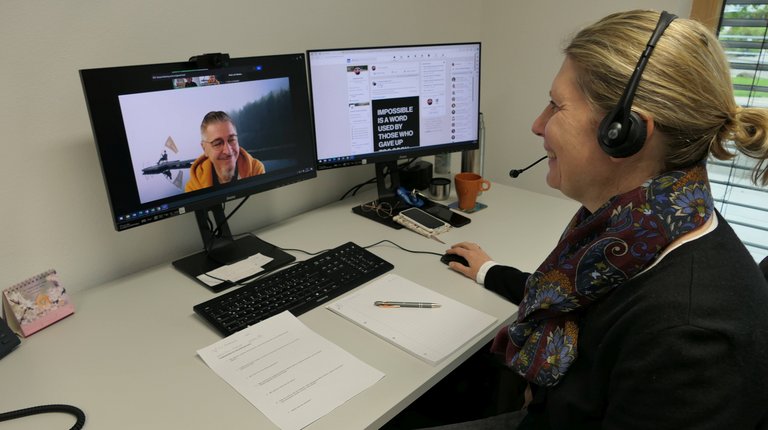
Prof. Tilo Staudenrausch, Professor of Corporate Communications and Digital Media, is celebrating his 40th anniversary of graduation this year and still feels connected to the Schloss-Schule. He takes up the cudgels for all those who have the courage to take creative paths and passionately supports students at the university as well as companies and managers in their respective development processes.
His appeal is: "Make it as easy as possible for children to work as hard as they need to!"
What is the first thing that spontaneously comes to mind when you think of your time at the Schloss-Schule?
The first thing that comes to mind is that I grew up during my time at the Schloss-Schule. I only came to the Schloss-Schule in year 10, when I was 16. Most of the people in my class were already older, on average 18 years old, already drove cars and did things that you did when you were 18 in the early 80s.
My dad was a dentist and one of his patients already had a son at the Schloss-Schule, so it made sense for me to go to Kirchberg too. The boarding school was actually always a "bargaining chip" for my father. Along the lines of: "If you don't study, you'll have to go to boarding school." And at some point I replied: "Okay - then I'll go to boarding school!"
That's how it all came about that I ended up in Kirchberg in the first place. I've always been rather open-minded, so arriving at the Schloss-Schule didn't cause me any difficulties. On the contrary, sometimes I even felt that I had more space here than at home and that the boarding school was my stage. I found the time extremely exciting for me personally.
Can you tell us something about your time at school before you came to the SK?
The integration of creative people in our education system is hardly or not at all successful. For me personally, there is nothing worse than the grading system. Many people only work towards a grade, but what is actually behind it or what potential is fundamentally present in the individual is unfortunately usually neither taken into account nor specifically promoted.
In my current role as a professor, I often notice resistance even from creative students because I work in a content-oriented way. The examinations are often project work. It's not about the one right result, but the development of a creative personality. This leaves room for development and there is more than just one right solution. This attitude initially irritates many, as they are simply shaped differently by our school system.
What has changed in Kirchberg?
There were people who were role models for me and who worked differently. Creative minds like Bruno Seeber, for example. If I may put it so casually - the Elon Musk of art teaching. I was able to accept more here and it was easier for me to approach things. Funnily enough, I then had a professor at university who I saw as the academic continuation of Seeber. I perceived these two as synchronous personalities. Both of them showed me and exemplified the unrestricted passion for what you do. Ultimately, I don't care what other people think of me. The focus is always on the cause and you are committed to it.
What actually changed in Kirchberg was that I met my girlfriend at the time, with whom I had been in a relationship for a relatively long time. And then I also started to take an interest in other things during this time. Even going out in the evening, sometimes illegally. But you would certainly have done that at home too.
What did you find formative? What values, life lessons and other things still guide you today?
I can't think of one particular thing off the top of my head. For me, it's more the conglomerate of everything. I think I have taken different things that were relevant to me from different people and personalities. There were very strong role models in the rhetorical field and also in the artistic field. You also learn from people you don't think are so good. You quickly realize what or how you don't want to be yourself.
I remember one saying: "If you don't do anything, nothing will happen." For me, this phrase means that you have to take your life into your own hands.
For example, I used to give rock 'n' roll dance classes. I learned things and taught them. I still do that today. Self-taught. Learning by watching, imitating.
There was definitely room for that at the Schloss-Schule. You could try things out.
I would have liked there to have been more music on offer. The early 80s were really incredible in terms of what was happening in music.
And then something else comes to mind. As a "boarding school kid", I am still the master of buffet food today. Somehow I intuitively learned when it was a good time to go to the buffet and get enough food.
I also learned how to network with people and differentiate between what is important and what is superfluous during my time in Kirchberg. If you're 16 years old and hungry at 3 a.m., it's advisable to be on good terms with the chef, Marianne at the time, otherwise you're just out of luck. (he grins) And that's still the case today. There are always people around you who are important and support you and who you can encourage yourself. You have to be attentive here. I learned that at the Schloss-Schule.
What happened after the SK?
In October 1984, I joined the German army for 2 years. I left there as a lieutenant in the reserves. It was clear to me that I wanted to have a position where I could help decide things, so I made a conscious decision to take this path. I also learned a lot in the Bundeswehr. For example, about leadership and how people change when they have "power".
After that, I really wanted to study design and passed the entrance exam for jewelry and industrial design at the second attempt. Before that, I trained as a goldsmith and silversmith. During this time, I had to make it clear to my father that I wasn't going to study dentistry.
After graduating, I was employed for exactly 3 months and realized very quickly that I didn't want to have a boss anymore in this life. I then set up my own business and have been self-employed to this day, now for 31 years. I run an agency together with my wife and support companies and managers with the challenges of positioning, corporate communication, innovation and implementation processes. I find it incredibly exciting to work with my clients to develop creative solutions to their problems. I also work as a freelance professor at the university. I need my freedom and the feeling that I can leave tomorrow. And I simply have a great urge for self-determination.
If you've ever had a class or year reunion, what stories and anecdotes should not be missed?
Generally speaking, I can say that I haven't regularly attended reunions in recent years. Nevertheless, I have a deep connection, which for me is not characterized by the quantity of meetings, but by quality.
Two anecdotes immediately spring to mind. Occasionally we would sneak out in the evening. Once we went to the cinema in Crailsheim and wanted to relax and watch our movie. Unfortunately, we saw too late that "Bo" was sitting two rows behind us. That got us into trouble with house arrest! And the other time we had similar "luck". We went to the water tower in Crailsheim in the evening, which was a pub at the time, and we bumped into two teachers as soon as we walked in. That really didn't go down well either! Of course, we were immediately sent home to boarding school.
Another thing that comes to mind is that there were public telephones in the corridors. If someone called the number, they rang, of course, and quite loudly. Those who had their rooms further up had "telephone duty", so to speak, because no one else answered.
What are you grateful for?
There are a lot of things I'm grateful for. I am very grateful that everything in my life has worked out the way it has so far. I am also grateful for my time at Schloss-Schul. My most defining characteristics are my carefree attitude and my optimism. I'm also grateful for that, because it often makes life easier for me. And I would also like to mention that I am also very grateful for my health!
Looking back on your school days, what would you do differently today?
Everything. I would definitely leave school earlier today and learn something "sensible". Something down-to-earth, like a plumber, farmer or something like that.
Would you like to support the school? If so, what could you imagine doing?
I could well imagine supporting the school. For example, showing how creative processes come about. I would like to do this within the teaching staff and also in the upper school. I was also involved in the careers information evening. I like to share my story to show that a lot is possible.
What else would you like to share?
My basic appeal is: "Make it as easy as possible for the children to work as hard as they need to!" Young people sometimes need a little pressure when they are being supported so that they can build up resilience. This is essential for the rest of their lives. You have to take away the kids' fear of mistakes and failure and be open to other paths and people!