When parents are considering a boarding school, the school’s educational philosophy, the quality of instruction, the student-to-staff ratio, and the extracurricular activities are usually—and quite rightly—at the top of the list of factors to consider. However, it’s easy to overlook the fact that another factor actually plays a significant role in shaping the daily lives of children and teenagers: food! After all, how, when, what, and in what atmosphere students eat affects not only their ability to concentrate and perform, but also the sense of community at school and in the boarding school.
At our boarding school, good food is therefore an integral part of our educational philosophy!
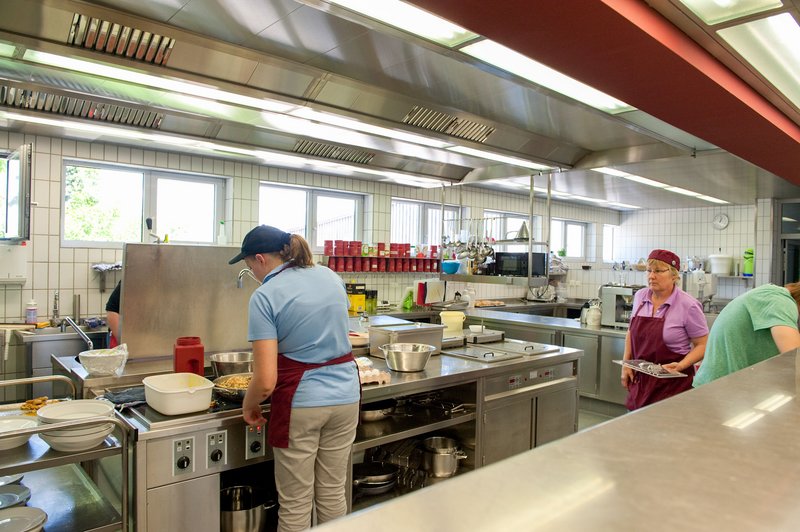
Our boarding school kitchen prepares all meals in-house, using fresh, high-quality ingredients. Meals provide structure to the day, and the shared dining rituals also create an atmosphere where students feel particularly at ease and can learn successfully.
From a physiological standpoint, the following points are particularly important to know:
In a nutshell: How does good nutrition affect academic performance?
Studies in nutrition and brain research clearly show that children who regularly consume complex carbohydrates, protein, healthy fats, and micronutrients perform better in terms of attention, memory, and problem-solving. In everyday school life, structured, fresh meals act as a “fuel booster” for the learning brain.
Good nutrition is the foundation for improved concentration and enhanced learning ability.
After all, learning takes energy—both physical and mental. Children and teenagers who go to class or study time hungry often have a harder time concentrating, get tired more quickly, and are more emotionally tense. Conversely, educational experience shows that those who start the day with a proper breakfast, have a nutritious meal at lunchtime, and are well-nourished throughout the day generally perform more consistently, remain more balanced, and are better able to engage with academic demands.
Especially in a boarding school like ours, where school and daily life are closely intertwined, good food is therefore not a secondary concern but an important foundation for successful learning and a positive school atmosphere.
Structured Daily Routine: Meals Provide Structure to Boarding School Life
At our Schloss-Schule Kirchberg, the daily routine for the boarding school is designed so that meals, study time, and free time follow one another in a logical sequence. The day begins with breakfast together in the dining hall. A second breakfast is served later in the morning, followed by a mandatory group lunch for all boarding students at noon. In the afternoon, afternoon coffee (or cocoa or tea) is served, and in the evening, there is a communal dinner.
This creates a clear rhythm: breakfast as a structured start to the day, a second breakfast to maintain concentration in class, a communal lunch as the calm centerpiece of the school day, a short afternoon coffee break between study periods, core classes, and free time, and dinner to wrap up the day and help students “wind down” after an intense day.
Between lunch and dinner, there are supervised study periods, class time, and leisure activities. Children and teenagers do not learn haphazardly at random times, but within a well-structured framework—and certainly not on an empty stomach. The subpage on the daily schedule at the boarding school details this routine, clearly outlining the rhythm of wake-up times, meals, study periods, and bedtimes.
What “good food” actually means at our boarding school
Good meals at our boarding school mean more than just filling the children’s stomachs. At our Schloss-Schule Kirchberg, meals are freshly prepared every day in our own boarding school kitchen, using high-quality, locally sourced ingredients whenever possible. Importantly, vegetarian options are always available, and we take individual dietary preferences, allergies, and intolerances into account.
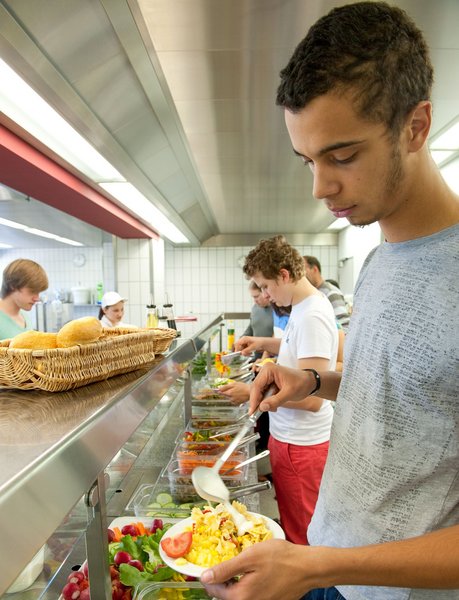
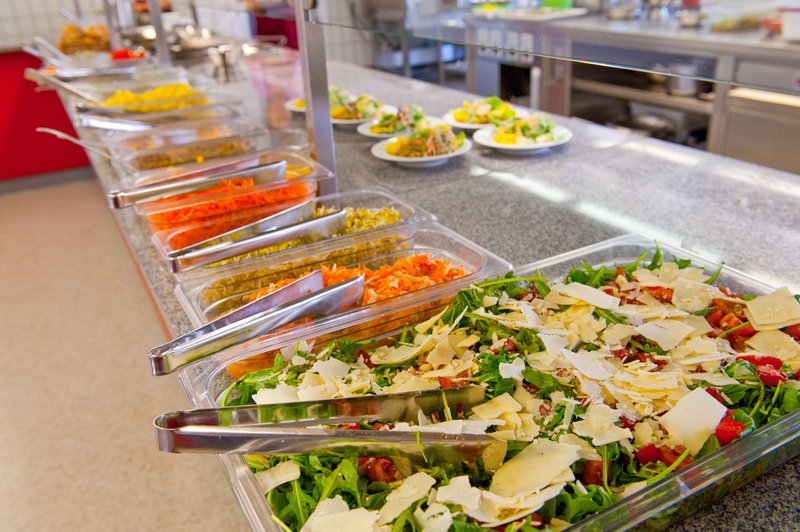
Lunch follows a clear structure: a large, fresh salad bar, a main course with and without meat, and a dessert. This is complemented by plenty of fruits and vegetables. This not only provides immediate energy but also instills an awareness of how a balanced diet can be put into practice.
The philosophy behind this is clear: The kitchen staff view the children and teenagers as “our children.” They actively seek dialogue, take requests seriously, and are delighted when students are satisfied and relaxed during meals. This not only contributes to their well-being but also has a positive effect on the atmosphere at the boarding school and the students’ willingness to focus on their studies afterward. For more insights, visit the boarding school’s “Culinary Delights & Enjoyment” page.
Shared Meals as the Heart of the Boarding School Community
Meals at the boarding school are always important moments of community. At lunch, there is a set seating arrangement and attendance is mandatory. At the end of the meal, a group “announcement” ensures that everyone is on the same page. In this way, the dining hall becomes a place where daily life is organized, community is experienced, and a sense of security is fostered.
For the school atmosphere, this means that children and teenagers experience the boarding school not as an anonymous accommodation, but as a manageable, reliable community. Those who feel seen and accepted here can often navigate the school day with greater confidence and inner peace.
A special highlight are the regular “formal dinners.” On these evenings, everyone dresses up, and a multi-course meal is served; for example, as part of a Thanksgiving dinner or a Chinese New Year buffet. Such evenings combine culinary experiences with a vibrant community culture and offer insights into different traditions. This, too, shapes the atmosphere and strengthens the sense of belonging at the boarding school.
Nutrition, Values, and Responsibility: What Children Learn in the Daily Life of a Boarding School
At Schloss-Schule Kirchberg, nutrition goes beyond mere meal service; it is also a matter of values. The children and teenagers learn to take responsibility for their own health, ensure they stay properly hydrated and eat a balanced diet, appreciate food and avoid waste, and engage with issues of sustainability and local sourcing.
In this way, the boarding school kitchen complements the school’s educational profile: caring for oneself and others is one of the core values taught at our Schloss-Schule. Eating and drinking thus become a practical learning experience for mindfulness, responsibility, and respect—all qualities that are also of great importance for getting along in the classroom and at the boarding school.
Academic Success at Boarding School: The Interplay of Structure, Atmosphere, and Meals
A boarding school cannot automatically “produce” academic success, but it can create the conditions under which learning comes more easily. The key lies in the interplay of clear daily and weekly structures, supervised study periods, and reliable rest periods; a supportive community; high-quality, regular meals; and caring adults who attentively guide the students through their daily lives.
At our boarding school, Schloss-Schule Kirchberg, all these elements are carefully interwoven: The boarding school kitchen provides the physical foundation, the structured daily routine offers stability, shared meals strengthen the atmosphere, and the educational support connects all of this with learning. This creates an environment where the school atmosphere and academic success mutually reinforce one another.
How families can experience this daily life for themselves
Parents and children who want to see if this environment is a good fit for them have several options: a trial meal during a visit, for example, to get to know the food, atmosphere, and kitchen staff in person; a trial stay at the boarding school (for the children), during which they can experience the typical daily routine—including all meals, study periods, and on-site recreational activities, as well as an initial overview of the boarding school concept, the culinary offerings, and the daily routine at the boarding school via the relevant subpages of our Schloss-Schule website, e.g., at https://schloss-schule.de/internat/, https://schloss-schule.de/internat/kulinarisches/, and https://schloss-schule.de/internat/tagesablauf/.
For those who would like more detailed information, the Schloss-Schule Kirchberg also offers the option to request information or contact us directly for a personal consultation. This makes it easy to assess whether your child would feel at home here—and whether the Schloss-Schule Kirchberg is the right place for his or her continued academic and personal development.