Plea for a beneficial school subject that still does not have the status it deserves
Yes, almost every school has them: artistic and performing arts courses such as the musical club, the choir, the student big band or even theater groups. But culture and theater are still often degraded to a minor matter. "Yet theater in schools is the area that needs to be defended the most," emphasizes Lars Saltuari, who has been teaching theater clubs and courses at the Schloss-Schule grammar school in Kirchberg for almost 20 years. He is not alone in his view that there is "huge potential" in drama, which has a positive effect on pupils' social skills and personal development. The positive experiences from countless school projects or pedagogical models that confirm the valuable educational and learning effects of theater are widespread. It has even been scientifically confirmed that theater educators are apparently right with their observations and assumptions.
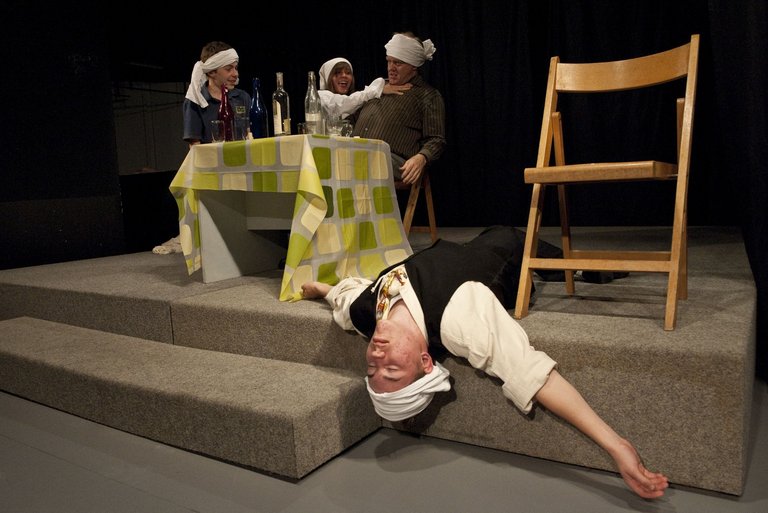
Theater subject under "pressure to justify"
The introduction of the school subject "Performing Arts", "Literature and Theater" or "Theater and Film" into the curricula of upper secondary schools, and occasionally also at comprehensive schools, is certainly an important step forward. In some federal states, including Lower Saxony, Rhineland-Palatinate, Hesse and Baden-Württemberg, it is even possible to take the Abitur in this subject, which is usually designed as an optional subject. However, theater teacher Lars Saltuari would not say that theater is on the rise in schools. "Especially after the Pisa shock, the subject of theater is still under pressure to justify itself," says the teacher. This is despite the fact that the positive effect of drama on personal development and the teaching of skills has been scientifically proven: In her dissertation, Romi Domkowsky conducted an impact study on drama in schools at the Berlin University of the Arts. In a comparison with a peer group, she was able to attest to an increase in openness, satisfaction and a more self-confident demeanor among the students playing theater after just one year. At the same time, the current professor of childhood education at the Berlin University of Applied Sciences referred in her study to a lasting learning and performance effect of theater play, as it is apparently associated with learning modes "that have a deep implementation effect", according to the author.
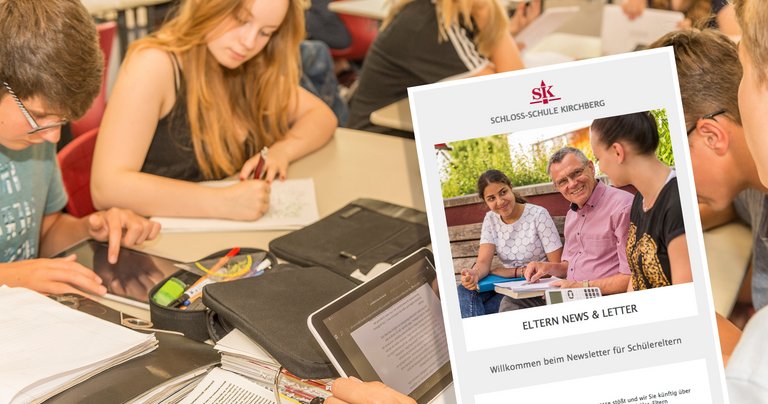
Theater mobilizes - body, mind and soul
"Year after year, I have students in my theater courses who benefit noticeably from acting - also retroactively on their school performance," Lars Saltuari confirms the beneficial effect of theater practice at the Schloss-Schule. The training of their own perception and the perception of their classmates, the mobilization of all senses, the memory training, the reduction of shame and insecurity by strengthening physical presence and, last but not least, the organization and reliability in the team - the theater teacher can confirm all these effects from the sum of his experiences. "Everyone is tapped into their strengths," explains Saltuari, "regardless of whether they are involved as actors, directors, music experts or stage technicians."
"Theater is school the way I want it to be"
A concrete example? There are many, says Saltuari. Like the pupil who the teacher "almost dragged into drama" because he didn't make enough use of his clear strength of being able to empathize with characters in German lessons. The result: the boy played the leading role in Georg Büchner's "Woyzeck" in the final production and his school grades also went up. "For me, theater is simply the kind of school I want," Saltuari affirms.
Theater teachers like Lars Saltuari even use the evaluations and grades in the (upper school) courses for a further learning effect: the students are trained in their "neutral view" by critically evaluating each other. "You don't have to wrap the students in absorbent cotton, because they learn to give fair and well-founded criticism and also to see themselves from the outside. They realize whether their presentation was more or less successful."
Why is the establishment of theater as a school subject only making slow progress despite all the interdisciplinary enrichment and promotion? "Unfortunately, it is not an immediately quantifiable subject and has hardly any place in our performance orientation," says Lars Saltuari. There is also often a lack of teachers like the Kirchberg teacher who take the helm and invest a lot of time in theater courses or theater clubs.
"Doing theater" allowed - with or without a curriculum
In any case, the students' interest in drama at school is not a problem. Quite the opposite. "We regularly have two, if not three, drama clubs in the lower, middle and upper school, sometimes even alongside the two-hour upper school course 'Theater and Literature'," Saltuari explains. "And when we have our annual theater camp, a quarter of the students are often gone." There is obviously a keen interest in drama among pupils, which is why a few schools in federal states such as Bremen, Berlin and Hesse also offer the subject as a basic course in the upper secondary school. In the curricula of primary and secondary schools, on the other hand, the school subject "theater" is more than rare when looking at the compilation of the Bundesverband Theater in Schulen e.V. (Federal Association of Theater in Schools). In grades 1 to 4, only Hamburg focuses on the promotion of drama.
But curriculum or not, "ways and means should always be found to integrate theater at school - even outside of the curriculum," appeals Lars Saltuari. At the Schloss-Schule in Kirchberg, Baden-Württemberg, theater has been a tradition for decades. With the "fabrik", the culture and workshop center, the school even has its own stage on which the students can - and should - "do theater" at any time.
The Schloss-Schule Kirchberg
Founded in 1914, Schloss-Schule Kirchberg, Baden-Württemberg, is one of the best-known boarding schools in Germany. As a non-denominational private school and state-recognized grammar school, it offers around 200 local and 100 boarding students optimal learning and development opportunities.
Press contact:
Schloss-Schule Kirchberg an der Jagst GmbH
State-approved grammar school with boarding school
Phone 07954 / 9802 - 0
Email: info@schloss-schule.de
www.schloss-schule.de