Parents and teachers are crucial factors that can help
Nervousness before exams - almost everyone is familiar with this! In fact, it has been proven that the brain performs best when you feel a little pressure. However, more and more pupils and students are suffering from real exam anxiety, i.e. an extreme concern about being able to meet the upcoming performance requirements, which can threaten their self-esteem.

According to estimates and psychological studies, around one in four pupils and more than 50 percent of students are affected. In addition to the quantitative increase, a qualitative change can also be observed, i.e. "more extreme forms of test anxiety", observes Alexander Franz. What's more, the principal of the Schloss-Schule Kirchberg boarding school adds that it is particularly the already hard-working and talented pupils, especially girls, who suffer from exam nerves.
The observation that preparing for exams provides confidence, but does not protect pupils from exam anxiety, was confirmed in the Pisa study on pupils' well-being published this year: According to the study, more than 40 percent of pupils in Germany would be afraid of failing even if they had studied sufficiently. But what is the reason for this phenomenon - and above all, how can pupils be helped?
Root cause analysis and... "believe in self-efficacy!"
There are many possible causes: being overwhelmed by the subject matter, pressure from parents or society to achieve good grades, which begins as soon as the child leaves school after year 4, unsuitable learning strategies, university admission restrictions in the event of poor A-levels or even a downward spiral in the student's self-esteem. "In my opinion, exam nerves may be due to poor preparation, but what's more important is the students' lack of confidence in themselves. Children who believe in their self-efficacy, i.e. that they can influence their own success and make the most of what they have learned, deal with performance requirements more confidently," Alexander Franz is convinced. Two factors in particular can influence this: the parents and the teachers!
Influencing factors no. 1: Parents and teachers
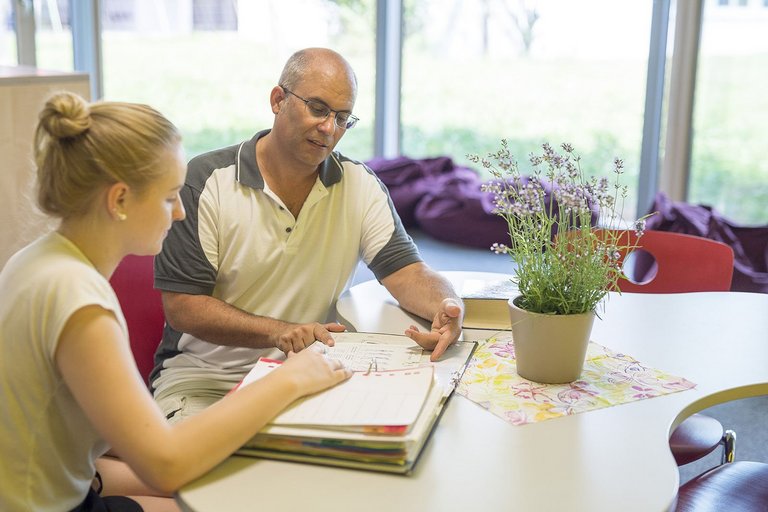
According to the Pisa study, both the attention of parents and the support of teachers are decisive factors for the satisfaction of pupils and can therefore have a significant impact on combating test anxiety. For example, a clear correlation was found between decreasing test anxiety in class with teachers who provide individual support and a sharp increase in test anxiety with teachers who evaluate students more strictly and trust them less. In other words, parents should simply be there for their children and make it clear to them that they like them regardless of their school grades. Teachers, on the other hand, could take a technical approach "by discussing gaps in knowledge and perhaps encouraging targeted revision together with homework supervision or tutoring," recommends Alexander Franz. "And they can take a psychological approach by trying to motivate their pupils, telling them that they will meet the requirements if they want to and make a reasonable effort."
In any case, the first signs such as headaches and stomach aches should be taken seriously. "You can tell if this is happening all the time," says Franz. If sleep disturbances occur over a longer period of time, i.e. not just once the night before the exam, he would strongly advise parents to talk to the teacher. This is the only way to filter out whether it is subject-specific exam anxiety or all subjects or even school anxiety and whether the individual, several pupils or perhaps the whole class is overstretched.
Reducing exam anxiety - tips that can help
Learning and exam strategies are also important for students who are anxious about exams: How do I study properly, how do I prepare papers or presentations in a structured way? "Learning to learn is institutionalized at the Schloss-Schule in the methods course, i.e. in a grade-free room that provides guidance right through to the upper school," explains the head of the Schloss-Schule. In the exam itself, students are advised to start with simple tasks and to read the questions thoroughly. However, if a blackout occurs during the exam, deep, conscious breathing can help as a quick relaxation technique.
Studying on the day of the exam itself is generally less recommended, as is offering the prospect of a reward for good grades - this would only increase the pressure to do well. Talking to other nervous examinees immediately before a test should also be avoided. "We offer students with high levels of exam anxiety extra rooms where they can write their exams alone under supervision," says Alexander Franz. However, if this no longer helps, additional therapeutic help together with parents and students should be considered. "When people come to us with extreme test anxiety or school anxiety, which we have also experienced with fainting spells, we deliberately offer the option of boarding school," says Franz, speaking from experience. "The aim is to reconnect the school side with the private side in the small school-boarding school unit without any anxiety - and we are very successful here."
Exam nerves, which can develop into extreme school anxiety, should therefore be taken seriously - in order to counteract them at an early stage. However, parents should generally make pupils aware of one thing: "Exams are never a matter of life and death," explains Franz with a wink!