Why boarding schools are also worth considering when changing schools
Tears over homework, slipping grades, learning difficulties - many parents are frazzled by the problems their children have at school. And the question of what to do next is even more of an issue. Repeat a grade, switch from grammar school to secondary school or to a school with a different educational approach? Deciding on a change of school and the supposedly best school for the children is a real challenge for parents.
Private schools and boarding schools in demand
Private schools and boarding schools are increasingly being included in these considerations as an alternative to traditional school types, as the figures from the Federal Statistical Office show: since 2001, the year the Pisa study was first published, private schools have seen continuous growth. In the 2016/2017 school year, more than 990,000 pupils, or one in eleven, attended one of the almost 5,800 general or vocational private schools in Germany. These also include around 400 to 450 boarding schools, which position themselves in the competition with their own focus. Their focus is often on the promotion of artistic or sporting talent, on a denominational and social value orientation and increasingly also on the individual promotion of high-performing - or low-performing - pupils.
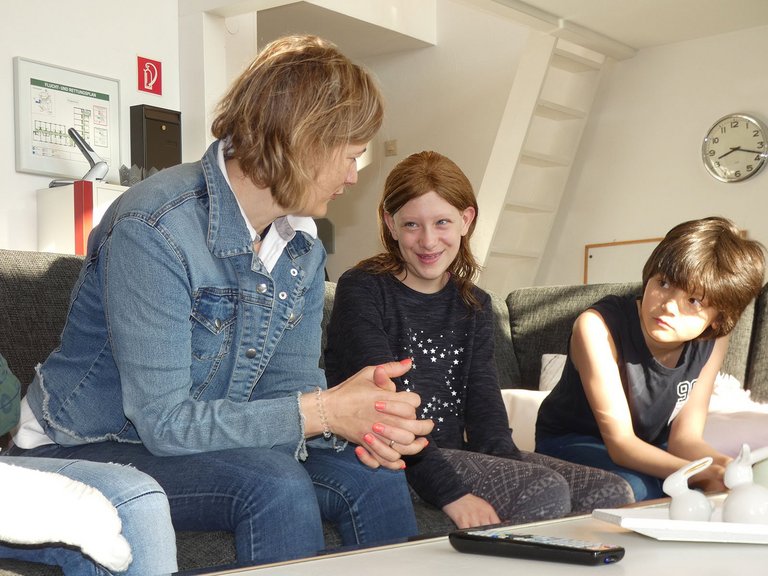
"When it comes to learning problems such as dyslexia, concentration disorders or other learning and developmental specialties such as Asperger's autism, teachers in large classes simply have their limits," says Melanie Wies. In addition to small classes and the intensive, direct supervision, the head of boarding school at Schloss-Schule Kirchberg also sees the increasing pressure to perform at schools as a reason for choosing a boarding school. "More and more children are coming to us who are actually clever, but who can't cope with the pressure of demands," explains the teacher.
Boarding schools at the cutting edge
Also against the background that sole earners are no longer the rule, but often both parents have to work, boarding schools are a good solution for many families to provide their children with the full-time professional care that they themselves cannot afford in their stressful everyday lives. One mother from Waiblingen, whose two children attended the Schloss-Schule Kirchberg boarding school and completed their A-levels there, believes that the accusation of "simply abandoning children at a boarding school" is no longer appropriate in view of today's family dynamics and often unstable family life. "For us, it was important to be relatively close to home, but above all the question of how a school or boarding school specifically wants to deal with our children's learning problems," she explains.
Providing security - why structure is important in everyday life
Boarding schools such as Schloss-Schule Kirchberg support the children by providing fixed structures for their everyday learning and living with partly individualized learning plans. "Rituals are good and give children and adolescents in particular security and stability," emphasizes boarding school director Melanie Wies. Educational scientists and studies such as the AOK Family Study even confirm that "too much parental stress and an unstructured everyday life" make children ill and "increasingly lead to mental and physical problems in the offspring." At boarding schools such as the Schloss-Schule, the day therefore begins with a shared breakfast and everyone also sits together at the table for lunch and dinner to discuss the day's events; the afternoon work session is spent together - all rituals that give the children a sense of family togetherness.
Especially with regard to targeted learning support, boarding schools also benefit from short distances between school and private life, between educators and teachers. "We regularly coordinate with the teachers, simply go over quickly and can therefore constantly review or adapt the learning plans of the individual pupils," says Melanie Wies. An intensive coordination that parents could not achieve even with the best will in the world and constant contact with teachers.
Good reasons for choosing a boarding school
There can be many reasons for choosing a boarding school: Parents' professional reasons, an educational school concept that is not offered close to home "or a deliberate change in the children's environment to get them out of a difficult development phase and unsuitable society," adds Melanie Wies.
When choosing a boarding school, in addition to the pedagogical orientation and conformity with the child's own educational principles, the language sequence, the qualifications to be achieved, the rules for traveling home and attendance as well as the leisure activities should also be taken into account. However, the boarding school director makes it clear that "children who come to our boarding school always want to come of their own accord". Ultimately, it is personal contact and a visit to the boarding school in question that makes the difference, as only a visual inspection can determine whether the child will really feel at home at a boarding school.
Looking back, it was also the initial personal contact in Kirchberg that convinced the family from Waiblingen, and not just the children. "It also allayed my fears as a parent, for example that I would no longer be able to experience everyday life with my children," recalls the mother. However, her concerns were soon dispelled when she saw how "incredibly independent and open-minded" her children became and "how relaxed we got together at the weekends."