In conversation with Leonie Wanner - December 2025
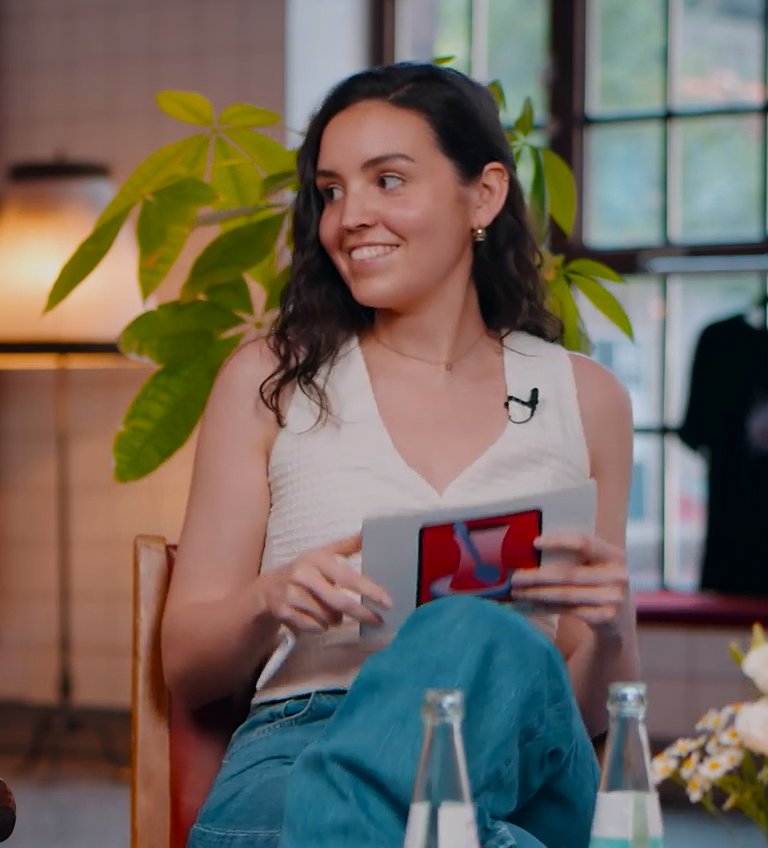
Online interview with Leonie Wanner - The former Schloss-Schule pupil successfully completed her Abitur in Kirchberg in 2016. She firmly believes that everything always turns out as it should and that the key to a happy and successful life is based on trusting yourself.
Leonie is very grateful for the support she has received. Her family, her friends and also many teachers have helped her to build up her belief in herself and this provides her with a stable foundation today.
What is the first thing that spontaneously comes to mind when you think of your time at the Schloss-Schule?
I immediately think of the small classes. This created a basis of trust for me. The opportunities for individual support were also much greater. For me, this meant that I had significantly more opportunities to develop, I could try out a lot of things and I was also able to experience my self-efficacy much more intensively and probably earlier. As a result, I was able to build up a lot more self-confidence and this still sustains me today.
What was the transition from elementary school to secondary school like for you? And what has changed for you at the Schloss-Schule?
The transition from elementary school to secondary school was the first time I consciously stood up for myself. I made a very conscious effort to come to the Schloss-Schule.
I got to know a lot of people at the school that I probably wouldn't have met otherwise. Thanks to the international character and the boarding school structure, I have come into contact with numerous young people from a wide variety of backgrounds and perspectives in my everyday school life, who have broadened my life, my horizons and my perspectives and enriched my wealth of experience.
What have you found formative? What values, life lessons and other things still stay with you today?
I was able to develop a lot of self-confidence at the school. I learned to trust in myself, in my abilities and in my path. This probably opened many doors for me that would otherwise have remained closed.
The togetherness and the community were also formative. The high regard in which the students were held, the way they were treated as equals and the constructive interaction.
What happened after the SK?
I studied sociology and political science in Würzburg straight after leaving school and completed my bachelor's degree in 2020.
During my bachelor's degree, I also spent some time in Zambia, where I worked for the Friedrich Ebert Foundation on workers' rights and social security. The foundation is committed to social democracy.
Immediately after graduating in Würzburg, I was the first in my family to start a Master's degree in peace and conflict research in Frankfurt. A scholarship from the Friedrich-Ebert-Stiftung enabled me to concentrate fully on my studies and not have any financial worries. I am very grateful for this. During my Master's degree, I had the opportunity to attend two UN conferences in New York and one in Vienna. It was all extremely impressive for me. I had the feeling of being part of something really big. One thing that sticks in my mind is when I was able to experience António Gueterres. It was almost unreal to sit two meters away from him and next to the German ambassador. At the UN conferences, I was part of the German government delegation to the Women's Rights Commission and also a youth delegate on the subject of nuclear weapons. In this context, I also had close contact with the embassies and was able to hold countless discussions with diplomats. It was a great time that I wouldn't want to have missed.
Since October 2024, I have been project manager at the "Ruhrpott für Europa" initiative of the non-profit NGO Young Politics. It has set itself the task of offering low-threshold political education for young people. The topics of European coexistence, democracy, loneliness and much more are covered here. Our work is aimed in particular at young people with a history of migration and/or from low-income families. We make podcasts, magazines, events and create meeting places. I feel very comfortable and have arrived for the first time. The size of the company gives me the opportunity to work in many different areas. It's really great and very varied.
At some point in the future, I could well imagine dedicating myself to more global topics. With the experience I have already gained and am still able to gain.
Are you still in contact within your year group?
I still have very good contact with somestudents. Groups have formed within the cohort, but we are still in touch. The many shared experiences over the years have definitely welded us together.
What are you grateful for?
I am very grateful that I always had people around me who believed in me and supported me. My family, friends, many teachers - everyone believed in me and that made me very strong.
I am also very grateful for the scholarships, which made it much easier for me to get a good degree. I didn't have to worry about existential matters and was able to concentrate much more efficiently on my studies.
And I am also very grateful that I was able to have these impressive experiences at the UN as a young woman.
Looking back on your time at school, what would you do differently today?
I wouldn't do anything differently. Every experience was good as it was and makes me the person I am today.
Would you like to support the school and the current students?
If so, what could you imagine doing?
Spontaneously, I could well imagine telling the current students about my experiences and presenting my study path.
Is there anything else you would like to share?
Finally, I would like to reiterate and emphasize that it is important to believe in yourself. This is the key! You shouldn't let hurdles stop you, even if they seem insurmountable. It is important to go your own way, regardless of whether everyone understands this.
Everything always turns out as it should!