No two boarding schools are alike. It is important to recognize the differences and choose the one that is right for you!
This is because boarding schools differ not only in terms of location and facilities, but above all in terms of their educational approach, their learning culture, the specific school and leisure activities they offer, and the way in which children and young people are supported on their journey to adulthood.
The following article aims to provide parents (and, of course, children and young people themselves) with answers to these questions for our boarding school, Schloss-Schule Kirchberg. But first:
What does “boarding school profile” actually mean?
A boarding school profile describes the overall concept according to which the school and boarding school work together. This includes, among other things:
- Educational approach and values
- Type of learning support and encouragement
- Academic focus and profiles
- Leisure, sports, and creative activities
- Structure and daily routine at the boarding school
Crucial for parents and schoolchildren: the boarding school profile has a decisive influence on everyday school and boarding school life – academically, personally, and socially.
Support and guidance: a central component right from the start
In a development-oriented boarding school with a secondary school like ours, individual support begins as early as grade 5. This is because, especially at the beginning of secondary school, many children need:
- clear daily structures
- reliable caregivers
- supervised study periods
- support in “learning to learn”
This individual form of support is therefore also a central feature of our boarding school profile, which focuses not on early selection but on stable development.
More in-depth academic profiles are added later – as an offer for specific further development. Read more about the connection between school and boarding school here.
Academic profiles from grade 8: Deepening strengths in a targeted manner
A boarding school with a holistic approach like ours is, of course, first and foremost a classic secondary school in accordance with the guidelines of the state of Baden-Württemberg, with a solid educational foundation:
- English from grade 5
- Latin or French as a second foreign language
From grade 8 onwards, our profile-building specializations enable students to develop their individual interests in a targeted manner – as a supplement, not a replacement.
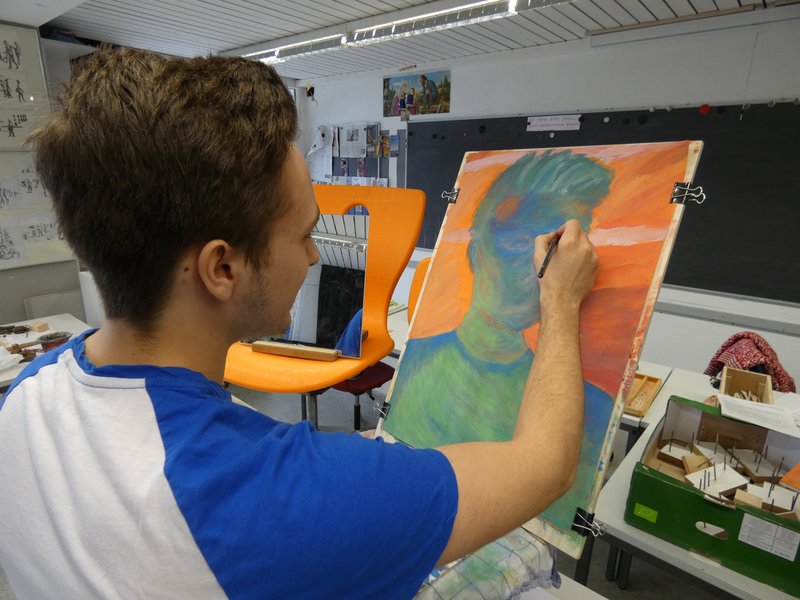
Profile: Fine Arts
Art is not a minor subject here, but a core subject that counts toward promotion.
Students work creatively, reflectively, and practically – supplemented by theater and music offerings.
Suitable for children who learn through design, expression, and creativity. Find out more here!
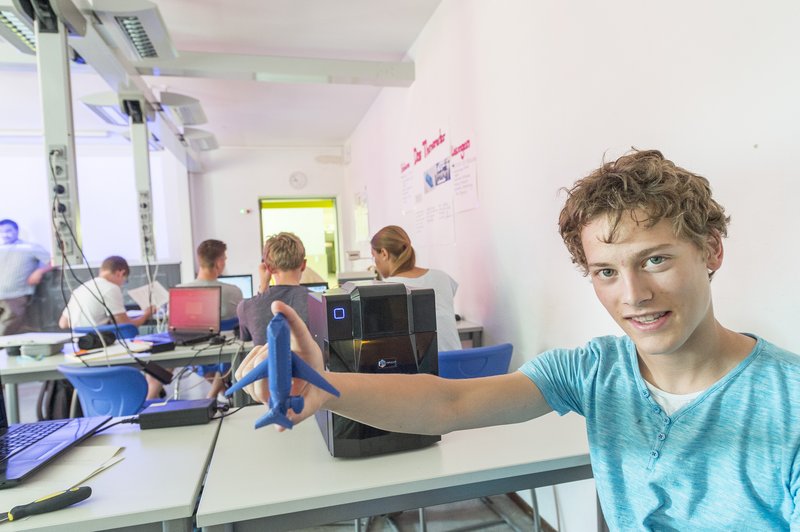
Science & Technology Profile
This profile promotes scientific thinking through experimentation, observation, and application.
The focus is on curiosity, problem-solving skills, and technical understanding.
Particularly suitable for inquisitive, analytical, and practical children. Find out more here!
Spanish profile – additional profile language
In addition to English, French, and Latin, Spanish can be chosen as a profile subject from grade 8 onwards – even as a late-start foreign language.
For students with: a particular interest in languages, international openness, and a special enjoyment of multilingualism. Find out more here!
Sports & more at Schloss-Schule: diversity instead of restriction
A key quality feature of a good boarding school profile is the diversity of activities offered outside of class. After all, a targeted balance to learning is always important for positive development, and a lively community and the pursuit of personal interests and inclinations are conducive to this.
Specific sports activities
Sports are an integral part of boarding school life at our school. In addition to a wide range of musical, artistic, social, and community opportunities for involvement and leisure activities, sports activities in particular are a very important element. Two areas stand out in terms of what is offered and the support provided:
- Equestrian sports as a long-established program with particularly high educational standards and as an offering for children and young people with different levels of experience and ambitions (from beginners to competitive riders, including tournament sports). Find out more on our dedicated equestrian sports page.
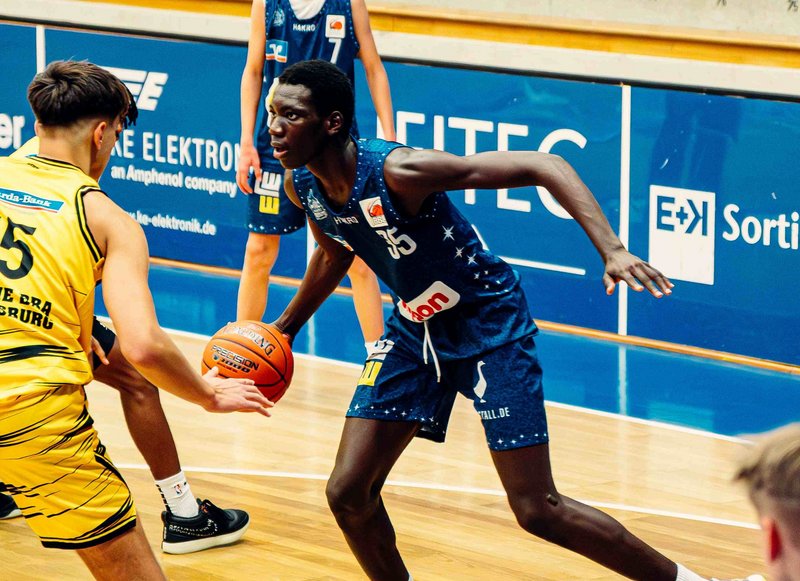
- Basketball as a structured program in close cooperation with a regional professional basketball club. Find out more on our dedicated basketball page.
Music, art, and crafts
Music, theater, creative workshops, and crafts open up additional opportunities for development. Children who do not grow exclusively through cognitive learning benefit particularly from this diversity. Find out more.
Which children are particularly well suited to a boarding school profile like ours?
A development-oriented boarding school profile like ours is particularly well suited to children who:
- need structure and guidance at an early age,
- want to discover their interests step by step,
- want to experience a good balance between school, leisure time, and community,
- want to live in a manageable, personal environment,
- and (very importantly) for whom it is particularly important to be recognized as an individual at school and boarding school and to feel completely comfortable on this basis!
How parents can find the right boarding school profile
The following three guiding principles are particularly helpful when choosing a boarding school profile:
- Where does my child need support?
- What motivates them in the long term?
- Where do they feel safe and taken seriously?
Personal conversations, impressions on site, and gut feelings (from parents AND children) are then the key decision-making aids in the final selection.
FAQ – frequently asked questions about boarding school profiles
1) What exactly is meant by “boarding school profile”?
The term “boarding school profile” refers not only to the type of accommodation, but also to the overall concept according to which the school and boarding school work together: educational approach, learning support, daily structure, community, academic focus, and academic and extracurricular activities. This profile shapes everyday life – and thus also how your child develops academically and personally.
2) How can I tell if the profile of Schloss-Schule Kirchberg is a good fit for my child?
A good match is usually given if your child...
- benefits from structure and reliable support,
- feels more comfortable in a manageable, personal setting than in anonymous large systems,
- should/wants to develop their strengths gradually (not only through grades),
- needs a balance between school, leisure, sports, and creative activities.
3) When does individual support begin at Schloss-Schule Kirchberg?
Support begins as early as grade 5: through clear daily structures, designated contact persons, and guided learning phases. The goal is for children to gain confidence early on, develop learning strategies, and integrate well into the community—so that their further development is stable and successful.
4) Does “profile” at Schloss-Schule Kirchberg mean that my child will be pigeonholed early on?
No. Profiles are not pigeonholes. They are intended to highlight and strengthen interests and talents. Many children only develop their preferences over time. The key thing is that the environment enables development – without prematurely pigeonholing them as a certain “type.”
5) What school profiles are there – and when do they become relevant?
From grade 8 onwards, students at a Baden-Württemberg (boarding) secondary schools, such as our Schloss-Schule Kirchberg, can deepen their strengths in a school profile (in our case in the creative, scientific-technical, or linguistic areas). Important: However, fundamental individual support and encouragement begins much earlier at our school—the profiles from grade 8 onwards are to be understood as a deepening of existing skills, not as the beginning of encouragement.
6) How is the language program structured – and where does Spanish fit in?
The secondary school is based on the classic language program: English from grade 5 and, depending on the career path, French or Latin as a further foreign language. Spanish is added as an additional profile option from grade 8 for students interested in languages, thus expanding the program (without replacing the foundation).
7) What role do horse riding and basketball play – is Schloss-Schule a sports boarding school?
No. Schloss-Schule Kirchberg is not purely a competitive sports boarding school. Sport is promoted ambitiously, but with a sense of proportion – as part of a holistic development. Horse riding and basketball are visible focal points where a high level of sport is possible, but there are also other sporting opportunities. The important thing is balance: school, community, and personal development remain equally important.
8) Are there musical, artistic, and craft activities in addition to sports?
Yes. A central feature of the profile is the wide range of leisure activities – for example, in the musical, artistic, and practical areas (e.g., music, theater, creative workshops, craft activities). These activities are not just “nice to have,” but important areas of development in which children discover their talents and experience self-efficacy.
9) As a parent, how can I check whether the boarding school profile is really a good fit?
The best way is to combine:
- specific questions (What does a typical day look like? How is learning supported? Who is the contact person?),
- your impression on site (atmosphere, tone, structure),
- an honest assessment of your child (do they need more peace and quiet, community, guidance, freedom?).
A suitable profile may not feel 100% “perfect,” but it should definitely feel right and sustainable.
10) What questions should I definitely ask during the consultation?
The following 6 questions will help you to realistically assess a boarding school profile for your own child:
- How is the child supported in settling in and learning from grade 5 onwards?
- How is learning time organized – and who provides specific support?
- How is community life organized (house community, rules, conflict culture)?
- What leisure activities are available and how are they integrated into the weekly schedule?
- How can interests such as horse riding or basketball be combined with school – without pressure?
- How is development monitored and communicated to parents?
The “right” boarding school profile is not recognized by buzzwords, but by how well it fits the personality and development potential of a child. A holistically oriented boarding school like ours combines academic education, individual support, and a wide range of leisure activities to create a coherent overall profile.
Would you like more information about our boarding school?
The best place to start is our overview page, or simply click now to: