Awaken a (new) desire to learn?
Why it is so important for the Schloss-Schule to keep "thinking differently" about school.
Only one in three German children in grades five to ten enjoys learning. This is the alarming result of a representative survey from 2020, especially because this figure is still around 53% for 6-year-olds - as other studies have found. This raises the question: how can the desire to learn be maintained or reawakened during school (and afterwards!) - and how does the Schloss-Schule actually deal with this issue?
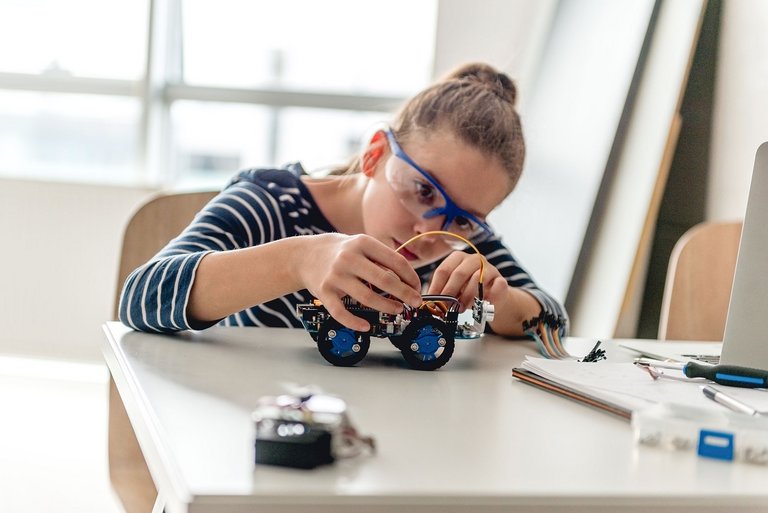
Logically, learning is not always fun. After all, learning is sometimes associated with effort. The people responsible for running the school at the Schloss-Schule are convinced that this should never be concealed from the children and young people. Nevertheless, those responsible are also certain that it is possible to (re)awaken the intrinsic desire to discover and learn that is always (!) present in young children and usually still present in primary school children, even in older children and young people.
1. "Live, learn and work" as a basic principle.
Schloss-Schule Kirchberg's guiding principle has proven its worth across all curriculum revolutions and "revolutiönchen" - even if it is of course subject to continuous change in its details. Learning simply "works" particularly well when this learning is embedded in a meaningful way - and is not an end in itself.
Read more about the mission statement of Schloss-Schule Kirchberg
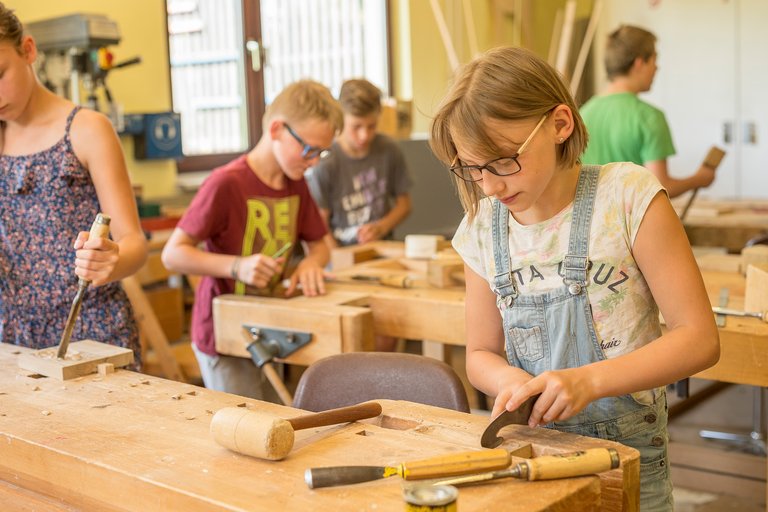
As different as children and young people are and as diverse as their inclinations, abilities and potential, they should also learn individually. Both in terms of focus and, above all, in terms of the way they learn. This is absolutely crucial, especially for pupils in the lower and middle school. This is put into practice at the Schloss-Schule as part of SKIL - Schloss-SchuleKirchbergIndividualLearning.
This concept focuses on recognizing the special characteristics of each individual pupil and supporting them according to their potential.
- Find out more under Innovative concepts
3. autonomy is a central key.
The only way to learn really "well" - this is a very important pedagogical insight - is if you have the drive to do so yourself. This in turn requires self-determination in relevant areas and the ability to try things out without being graded. It is also extremely important to be able to make mistakes - and then correct them yourself. At the Schloss-Schule, therefore, comparatively extensive grade-free scope for development is granted - SKIL courses in the lower and middle school, for example, are not graded at all. Neither is participation in the various AGs and special interest groups at the Schloss-Schule.
Children and young people can also try out the wide range of artistic, creative and craft activities on offer at the Schloss-Schule. Pupils also learn to have a say and take responsibility - for example in the class council or in the SMV, i.e. the student council, as a student media mentor (SMEPer) or as a mediator.
This is also well described in our learning and teaching approaches at the Schloss-Schule.
4. the HOW is the crux of the matter.
Hanne Zilles, educational and didactic officer at the Schloss-Schule, describes the school's philosophy of helping children and young people to maintain (or regain) a love of learning as "a little cunning goes a long way". "Learning is a bit like climbing a mountain - not every second of the ascent is fun, but the view from the top is. That's why it's important to preserve these mountain experiences - and to use them as a motivational aid".
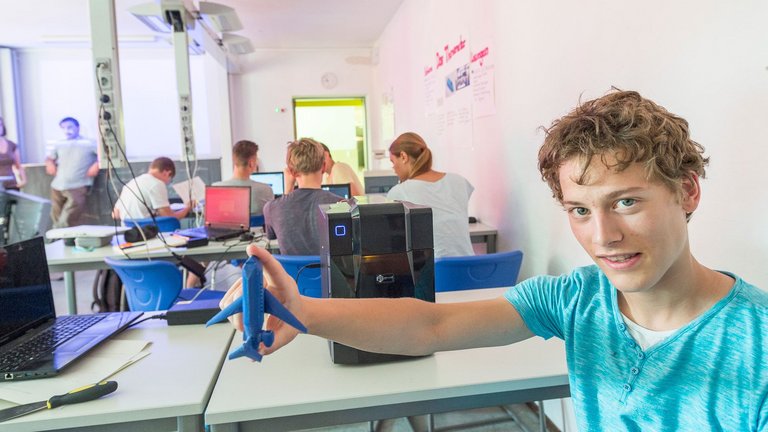
In addition to these and other motivational aids, the right teaching and learning methods are also extremely important. For good reason, there are special methods courses for pupils at the Schloss-Schule - after all, this is where they learn how to learn. And for the same reason, the teachers at the Schloss-Schule are also required to undergo continuous further training in order to optimize their teaching. After all, a desire to learn also requires a comprehensive desire to teach - and this, we are convinced, grows through the continuous development of the "how to".
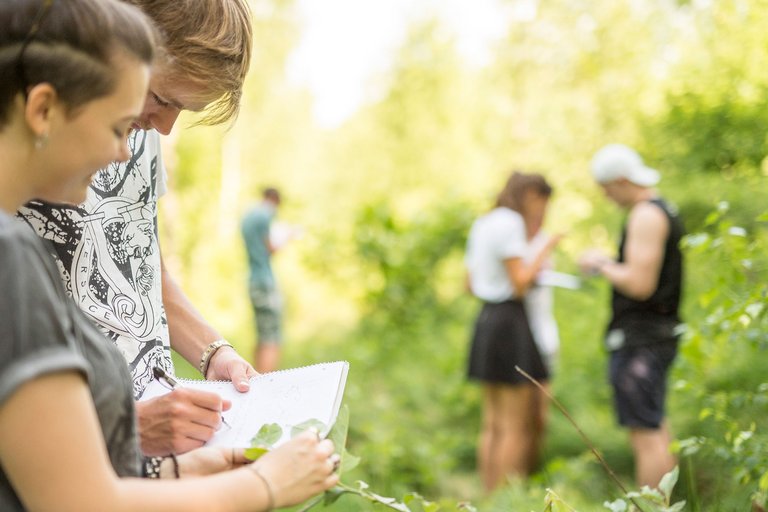
Logically, the Schloss-Schule cannot (and does not want to) simply throw the curricula prescribed by the Ministry of Education overboard. However, these curricula also allow for a certain amount of freedom - and this is actually used at the Schloss-Schule.
After all, the school is firmly convinced that in today's world it can be more important to understand basic principles and to know where or with which tools something can be researched - rather than simply cramming detailed data. One thing is certain: in the future, it will still be essential to learn vocabulary in order to learn a language, for example ... but otherwise, our society is struggling with too much information - and with helping people to successfully find their way through this mass of data and signals.
6. learning for life?
Yes, this saying can be heard and read endlessly and almost inflationarily - but at the Schloss-Schule it is actually put into practice. After all, the actual aim of the Schloss-Schule is to make the children and young people entrusted to it "fit" for the real world outside school and to give them access to a fulfilled and, above all, happy life.
The correct solution to an equation can certainly be relevant in individual cases, but - and the Schloss-Schule is convinced of this - especially when it is connected to the concrete reality of the pupils' lives. This is precisely why activities such as a social internship as part of the social curriculum, singing in the school choir or joining one of the many study groups are also very important to those responsible at the Schloss-Schule!
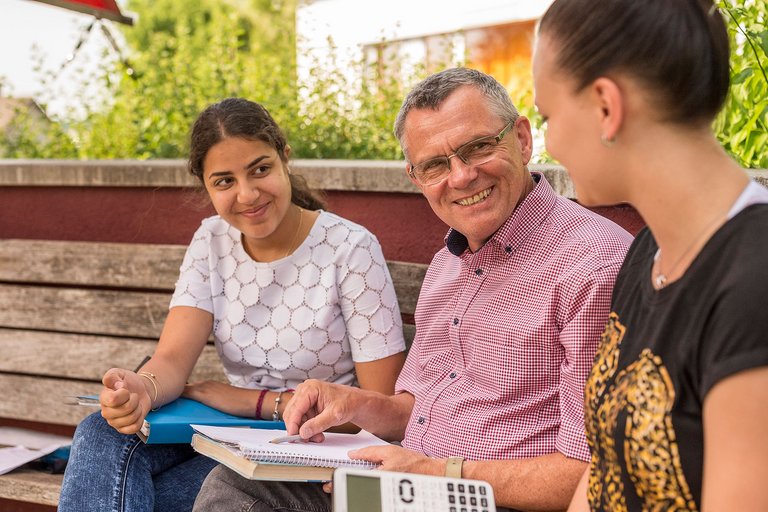
The importance of leading figures and role models for children and young people is often underestimated. Especially when it comes to the topic of "learning". By puberty at the latest, adults no longer seem to play a role for young people - at the Schloss-Schule, however, those responsible know that the opposite is the case.
The positive authority of the teachers and educators plays a very important role both as a guideline and as a source of friction. No one at the Schloss-Schule advocates blind obedience. But clear positions are fundamental. Just like the learning role model that children and young people can follow!
8. Very good framework conditions. Very good learning.
Small, manageable classes (currently with an average of 17 pupils), motivated teachers, modern technology (good Wi-Fi, up-to-date PC technology, several mobile iPad sets, powerful audio and video equipment, modern school software) - the Schloss-Schule certainly sets standards when it comes to the framework conditions for learning.
And development is still continuing. The best example of this is the new building on the Schloss-Schule site: the classrooms housed in it will have three times the space per pupil of the previous building! And for good reason. After all, the principle among school developers is that "space is the additional teacher". And there is plenty of space for them to develop - with room for an input area, a market area, individual work areas and many additional areas for self-determined movement and learning in the classroom. The Schloss-Schule is thus opening another exciting chapter on the subject of how to make children and young people want to learn.