How can teachers be relieved of the burden of inclusion in schools?
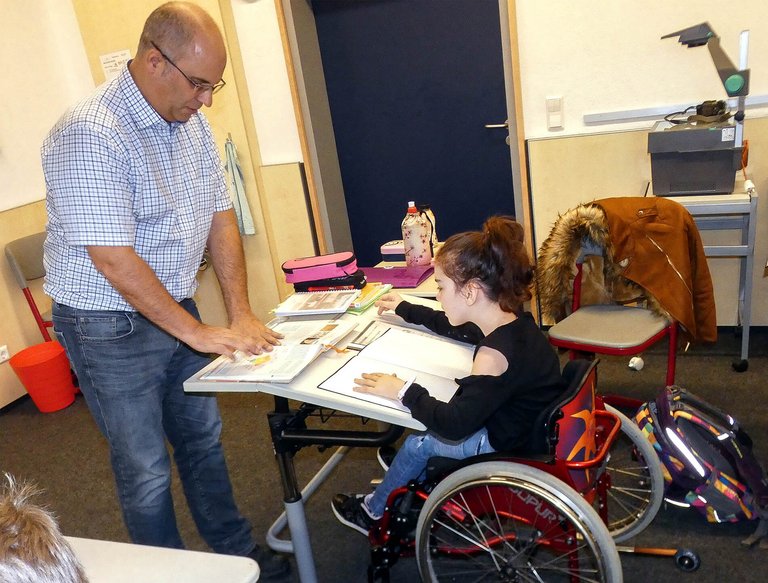
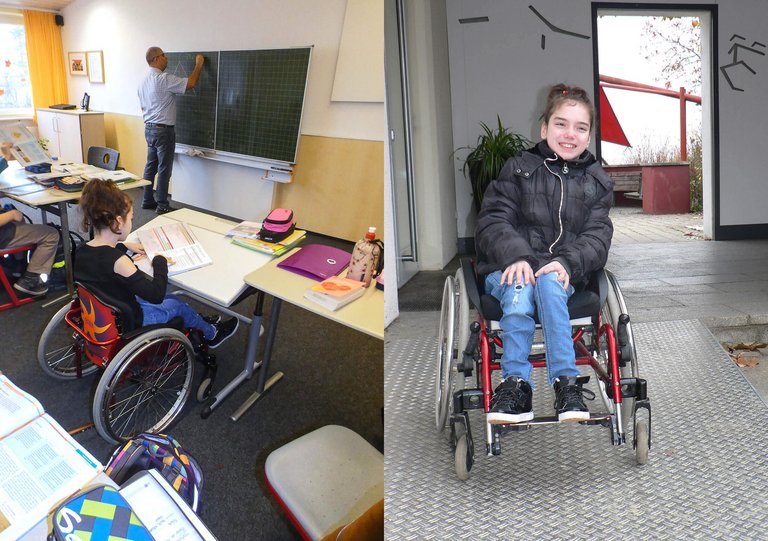
The goal of inclusive education is obvious: teaching disabled and non-disabled children together should support the positive development of children with disabilities, introduce them to everyday life and promote the social skills of all pupils. According to the UN Convention on the Rights of Persons with Disabilities, children with disabilities have a right to unrestricted access to the education system, and their parents now have the freedom to choose between mainstream and special schools. "Our daughter is mentally fit. If you put her in a normal seat in the classroom rather than in a wheelchair, she would only stand out when everyone else stands up," report Dirk and Janine F., who deliberately chose the regular school route for their daughter Leonie, who has a walking disability. In practice, however, as they found out, this is often not an easy path. This is because the practical implementation of inclusion at school is still lacking. This is mainly because, as a forsa survey of German teachers from 2017 and 2020 shows, inclusion work usually falls on the shoulders of teachers.
Poor conditions for teachers
Although the majority of teachers are in favor of joint teaching of children with and without disabilities, they also complain about the extremely poor conditions for this: above all, the lack of support from special educational staff - 65% stated in the last forsa survey that inclusion was only managed by one teacher. Other criticisms include the inadequate preparation with regard to the respective support needs, the often inadequate material, school construction or financial resources for inclusive teaching and the constant class sizes despite the addition of inclusive pupils. The sobering results confirmed that the majority of teachers at the almost 40 percent of German mainstream schools with an inclusion profile now simply feel overburdened and left alone. "We teachers also have a curriculum to fulfill. When an inclusion child is added to the mix, who also has really high support needs in the case of a learning or behavioral disorder, it is more than challenging to keep them on track with all the learning progress in the class," says Ralf Martius from Schloss-Schule Kirchberg, showing understanding for some of his overburdened teacher colleagues. "It works, we have been teaching pupils with Asperger's autism and visually or hearing impaired children in mainstream classes for years, for example. But it only works if the conditions are right," adds the teacher.
The be-all and end-all of making it work
At his school, the Schloss-Schule in Kirchberg an der Jagst in Baden-Württemberg, the classes are small. For inclusive pupils such as Asperger's autistic pupils or the blind pupil Maximilian, who was successfully accompanied through to his A-levels here, the school also works with constantly present school assistants. "They are the key to making it work," says Martius. This is because the support and preparation for an inclusion child who, for example, cannot see and therefore cannot read, goes far beyond the usual level of lesson preparation: the worksheets and teaching materials all have to be prepared and transformed into Braille characters - services that are provided in collaboration with school assistants. Leonie, who has been at the grammar school in Kirchberg since Year 5, can also rely on the help of a school companion if necessary. If necessary, she can be assisted on paths with larger obstacles or with hand motor problems - caused by spasticity throughout her body. "Everything we had to fight for before went without a hitch right from the start," Leonie's mother looks back: "The room swap for a larger classroom, the school escort, the construction of a ramp within a few weeks, the order of a height-adjustable desk before we even mentioned it."
Accepting inclusive challenges
"Of course, we also learn a lot by doing, especially as every case of inclusion is different," says Ralf Martius. Some colleagues have attended further training on inclusion, others have specialized in autism or Asperger's and a few lectures on inclusion have been offered at the school. But essentially, they benefit from the experience gained and the exchange of ideas between colleagues. "We hold regular case discussions in small groups here at the school, sometimes with psychologists. These have been very helpful for me in my work with inclusion pupils," emphasizes Hanne Zilles. The teacher at Schloss-Schule sees emotional-social developmental disorders, such as in pupils with Asperger's syndrome, as the main inclusive challenges. "The children have no sense of social contact, don't want to be touched by their classmates and feel uncomfortable in groups," explains the teacher. According to Zilles, you have to adapt to this in the classroom - in correspondingly small classes with barely more than 15 pupils. Group work has to be avoided, in essays such as experience stories, the pupils have to apply their lack of empathy by using set pieces they have learned to describe feelings, and a separate room is provided for class work. On the other hand, lessons benefit from the in-depth knowledge that Asperger autistic students in particular often display in certain subject areas.
Timothy is also an inclusion child at the Schloss-Schule, "but one who simply follows along in class," says class teacher Hanne Zilles. The hearing-impaired boy, who came to the Schloss-Schule Kirchberg grammar school in Year 5 with top marks, has been wearing cochlear implants since he was a toddler. During lessons, teacher Zilles simply had to adjust to speaking to Timothy a little more clearly, not over her shoulder, but from the front. "And I might use a little more gesticulation, although I don't think the smart guy needs it." If there are still problems with understanding, the two have agreed on a secret sign: Putting the UHU tube on the table means "please speak more clearly".

Made to fit - merging special and mainstream schools?
The examples show: Inclusion at schools, the mixed teaching of disabled and non-disabled pupils, can succeed - if the framework conditions are right for teachers and the pupils concerned. This is precisely where North Rhine-Westphalia is starting to adapt the conditions: From the 2019/20 school year, inclusion lessons at mainstream schools are to be tied to realistic(r) criteria. These include
- an educational inclusion concept for schools,
- Sufficiently trained teachers,
- suitable premises,
- the limitation of inclusive class sizes
- and limited inclusion at grammar schools - only for children with disabilities who are really up to the challenge.
Regulations that, according to the local Ministry of Education, once again put quality before quota and are also intended to preserve special schools. The latter have suffered considerable losses in recent years due to the freedom of choice in schools - even though they have precisely the specialized staff for children with special needs that are needed at schools with inclusion professionals. "Does it make sense to have support specialists there who, despite being urgently needed, cannot be deployed for inclusion at mainstream schools due to certain regulations?" asks Ralf Martius - and he is not the only one. The 2017 UNESCO resolution for inclusive education in Germany also does not talk about abolishing "special educational expertise", but rather about cooperation or merging special schools and mainstream schools. An approach that the majority of teachers in Germany would probably support: In the forsa teacher survey, almost 60 percent voted in favor of maintaining special schools and a full 98 percent consider a double staffing of regular school teachers and special needs teachers for inclusive education to be absolutely essential.