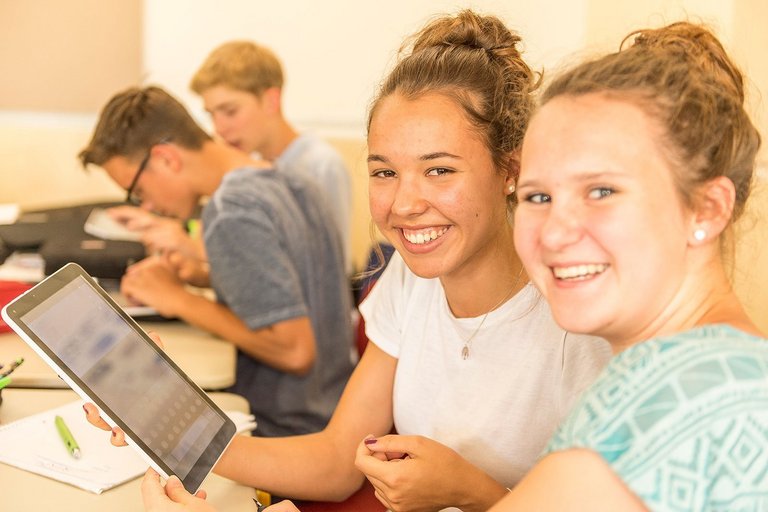
Targeted media education is based on four pillars.
Modern technical equipment is of course essential as the basis for contemporary media education. However, we believe it is even more important to provide pupils with comprehensive background knowledge about the opportunities and risks and to provide them with multi-dimensional guidance and support in dealing safely and effectively with the options available. We therefore rely on a media education concept that focuses both on teaching technical know-how and on teaching or strengthening social skills and moral competence. In many cases, this has less to do with technology and more to do with the person of the individual pupil. In fact, our private grammar school and boarding school Schloss-Schule Kirchberg an der Jagst has developed a media education concept based on the Baden-Württemberg state curricula and requirements, which is built on a total of four pillars:
- Contemporary technology (and the knowledge of how to use it),
- teaching that does justice to the opportunities and risks of today's digital media,
- the involvement of pupils by means of a pupil-helping-pupil concept and
- clear rules that are ideally also supported and enforced by the respective parents.
1. modern technology
The school's technical equipment must correspond to the digital-media reality of lifeWe believe that the decisive factor is that a school today must reflect the current digital and media reality of life in order to adequately educate children and young people. As a private school, we probably find it a little easier than others to make the necessary investments. But we also believe this is essential. It can't be that the smartphone of an 8th grader has a larger storage volume than the school's computers!
That's why every classroom and course room in our Schloss-Schule already has a projector, a high-performance laptop with a sound system and a document camera. One of the classrooms is also equipped with a Smart Board and a laptop trolley with a total of 20 laptops - so that with the maximum class size of 20 pupils at Schloss-Schule, everyone can be equipped with a device for the relevant tasks.
There is also a 3D printer and another laptop trolley in the science and technology room. The school also has an iPad case with a total of 20 iPads for a maximum of 350 pupils (a second case will follow). All teachers who work with them have also been equipped with an iPad. The school and boarding school are also equipped with a high-performance WLAN, which is - or can be - activated for a wide range of user groups and applications across several levels.
Regular training courses are held to integrate modern digital and online technology into lessons in a targeted manner. For example, there is an iPad teachers' group in which teachers with particular technical expertise train their colleagues. In order to introduce the children to the benefits of digital media, the Schloss-Schule also provides pupils from year five to eight with every textbook as an e-book, i.e. in digital form.
The renovation of the administration area was strategically used to turn the large music room into a large presentation room with an 85-inch multi-touch display and Dolby Surround 7.1 system. This makes it possible to carry out film analysis in cinema quality or to present film projects that have been created in-house.
Another pioneering room with virtual reality technology is also already being planned. This will make it possible to experience historical places, museums or other times in which dinosaurs lived, for example, in three dimensions and photorealistically in the classroom.
2. teaching that does justice to today's digital media
School of the person - as a school for "correct" digital media useBeing equipped with modern technology is important, but does not solve the question: how are pupils at the Schloss-Schule taught how to use this and, above all, their own private digital technology in a targeted manner? "In fact, we lay the essential foundations for this from Year 5 onwards," says Angelika Joachimsthaler, who teaches the grade-free subject 'Methods' at the Schloss-Schule.
"For example, we not only teach our fifth-graders how to use common software, but also the basic know-how for targeted search engine use and the correct classification of the search results found. The pupils should be able to distinguish between 'good' and 'bad' quality results right from the start!"
At least as important to us is teaching respectful interaction with one another - both in personal contact and via social media, for example. In the subject "Methods", but also in all other subjects, we focus on the comprehensive teaching of social skills. Pupils therefore deal with methods of stress management and non-violent conflict resolution - both in the acquisition of methods and in appropriate subject contexts in regular lessons.
We are certain that this aspect is not a technical issue. In this respect, subjects such as German, history or social studies can and must make a very significant contribution here.
Another important learning content in connection with the new media and digital technologies is the topic of "security and law". Both to protect themselves from data misuse by others and to avoid unknowingly breaking the law themselves. This is why this subject area also takes up a larger part of the specific lessons. In order to further sensitize the children and young people to this important topic, we regularly invite external speakers!
3. student-helping-student concept
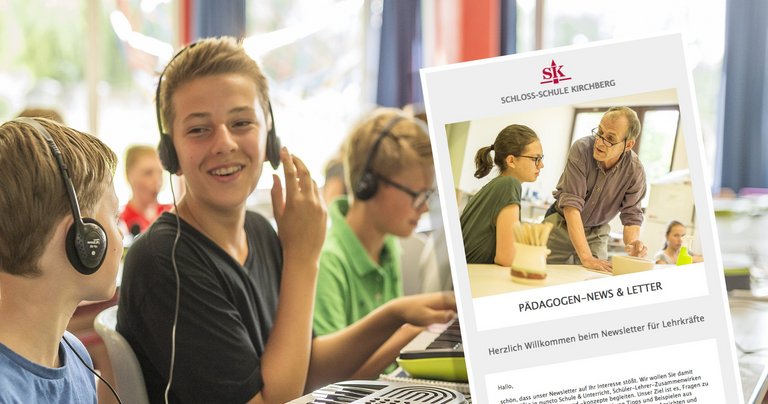
With the help of the SMEPerWe at the Schloss-Schule are also aware of this: Children and young people learn how to use digital media from other children and young people. This is precisely why we decided very early on to actively embrace this effect and enable pupils interested in digital topics to take part in the Student Media Mentor Program (SMEP) offered by the Baden-Württemberg State Media Centre, thus becoming one of the SMEP schools in Baden-Württemberg.
A total of 21 Schloss-Schule children and young people in grades five to ten completed 40 hours of training to become SMEP mentors at the end of 2018 and are now applying their knowledge to lessons and everyday life at the Schloss-Schule. "The range of our activities," says Damiano Müller, 16 years old and one of the two elected SMEP group leaders, "is wide - and ranges from creating videos for class projects to providing support with hardware problems or questions about security settings." In the meantime, with the support of principal Alexander Franz, a kind of SMEP school company has even been founded, through which multimedia or audio-visual contributions can be "ordered" from the SMEPers. Elias Peschke, 15, the second spokesperson for the SMEP group at Schloss-Schule: "We are always represented by at least one SMEPer in each class level and coordinate our requests so that younger SMEPers are supported by the older ones if necessary."
To ensure that the SMEPers are able to act, the Schloss-Schule has provided them with the appropriate equipment. Among other things, the group has a high-performance camera, an audio recorder, tripods, a high-performance (and adequately insured) flying drone and its own laptop for image and sound editing as well as for research. This technology will be gradually added to in the near future. "I think the technical equipment and skills we have acquired are also being recognized. Classmates already contact us from time to time with personal security problems or questions about behavior on the web. We want to expand this further and possibly offer the younger ones in particular help with their own small events if they are interested," says Damiano Müller. "In any case, the enormous effort involved in the training has really paid off," adds Elias Peschke, "through the SMEP program and with the support of the school, we can indulge in our hobby, have a certified additional qualification from the state of Baden-Württemberg and can help others to better cope with the possibilities of modern digital and media technology."
From next school year, a graduation concept with a points system is also to be introduced, in which SMEPers can specialize and continue their education. There will be four levels of specialization in each of the subject areas "Video", "Image", "Sound", "Technology" and "Media Protection", which can be achieved by successfully completing tasks and the associated points. Students who have reached a certain level can then train other students in this area. At the end of the course, the students also receive a certificate with the respective subject areas and levels achieved.
4. clear rules
Commitment can only be enforced with the support of parentsThe Schloss-Schule has clear rules regarding the use of digital media on personal devices: It is strictly forbidden to use your own smartphone during lessons - except for "use-your-own-device" research activities initiated by teachers. In everyday boarding school life, clear and age-specific usage rules have also been established with the active participation of boarding school students. It is also crucial that the school, boarding school and parents pull together - in order to communicate binding guidelines to the children and young people.
For this reason, we also organize regular parents' evenings - for example, together with prevention officers from the Baden-Württemberg police. At these evenings, the various dangers that children and young people are exposed to today are highlighted - as well as tips and advice on how parents can help their children deal with them by showing an honest interest in their children's activities and by providing clear and unambiguous guidelines and rules.
CONCLUSIONS:
The well-known children's book author and qualified teacher Dr. Manfred Hinrich once formulated the following sentence, which could be interpreted as a fear for the future: "Technology is galloping away from its rider".
To ensure that this does not happen and that children and young people use modern digital and online technology actively, purposefully and in a controlled manner (instead of being "driven" by this technology), it is important not to focus (solely) on teaching technical user knowledge, but to help them holistically to take advantage of the opportunities offered by these technical developments without ignoring the risks.