In conversation with Klaus Momper - December 2024
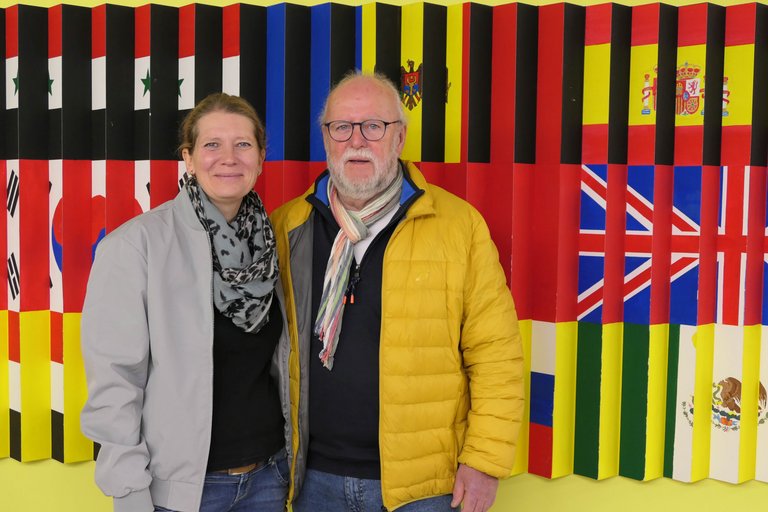
In conversation with Klaus Momper, who left the Schloss-Schule in 1971 and now lives with his wife on the Ostalb. He appeals to people to live by basic values such as mutual respect and consideration for one another and to be more grateful for what they have. These are all values and attitudes that were exemplified and taught to him at the Schloss-Schule. He is committed to cancer and children's cancer charities and is convinced that you get a lot out of giving!
What is the first thing that spontaneously comes to mind when you think of your time at the Schloss-Schule?
It was very nice and it was good that I was here! Spontaneously, that's the first thing that comes to mind. It was a really good time that I was able to spend here!
Would you like to tell us something about your time at school before you came to the SK?
I came to the Schloss-Schule at the age of 14, which was in 1967. I stayed here until I was 18.
I spent the first two years of my school career at elementary school in Upper Bavaria. Then we moved to a place near Bopfingen, where I attended the 2nd grade for another six months and then the 3rd grade. The reason for this was that the school years and the school system were different in Bavaria than in Baden-Württemberg. I went to a small village school. Three classes were taught in one room.
After a year and a half, we moved again and I went to the 4th grade elementary school in Bopfingen. I was then able to go to grammar school in Nördlingen at the start of the school year in Bavaria. The time at grammar school was difficult. I was always afraid of doing something wrong, especially because of my father's expectations. He was a dentist and it was clear to him that I should take over the practice at some point. The time was characterized by immense pressure, so I really wanted to leave home and go to boarding school. A child of a family friend at the time was already at the Schloss-Schule and that's how the connection to Kirchberg came about.
What changed in Kirchberg?
There were clear rules and camaraderie here. I was no longer afraid of living together or attending school. The teachers in particular were different here, they were human. You could talk to everyone. I also experienced friendships much more intensely here than before. That certainly had something to do with the many moves. It's simply more difficult to make friends here. What was also really different at the Schloss-Schule was that friendships developed across many different age groups. Living together in a boarding school is simply different to a "normal" school.
What did you find formative? What values, life lessons and other things still stay with you today?
The clear and sometimes strict rules were very important. Things were always extremely fair and the structures were therefore reliable. You always knew what your turn was and what to expect. Punctuality is another value that the Schloss-Schule instilled in me.
I always experienced living together with a lot of respect and consideration. As pupils, we always felt that we were treated in the same way. We were also praised from time to time and this is fundamentally important for everyone.
What I also remember well is that as a boy you had to wear short hair, otherwise you didn't get any pocket money. That didn't bother some people in the late 60s (he grins).
What happened after SK?
I left the Schloss-Schule after my secondary school leaving certificate. I went back home and then went to Aalen grammar school for year 11 and 12. After that, I volunteered for the Bundeswehr, but I wasn't accepted and didn't have to do any voluntary service. My mother then gave me the idea of going to hotel management school. I did and completed my training at Lake Geneva. My father paid for the school, albeit with resistance. There I learned French "properly" and traveled the world. Geneva, Munich, Hamburg, Cologne, .... I always stayed in big hotels. In the last hotel, I had a management position and was officially the boss's assistant. But in fact I managed everything on my own, as the boss himself was never actually there. It was a great, but also very stressful time! The reliability of the employees was already difficult back then, so I had to manage a lot on my own and work extremely hard. Often for days at a time. Unfortunately, I also fell ill. I had stomach ulcers - it was just too much and I knew I had to change something.
At my own request, I left the hotel business behind and started an apprenticeship as a dental technician with the help of my father. From then on, the relationship between me and my father relaxed again and he became much gentler. And it also made him really proud - that was nice! Initially, I also worked for my father. In 1981, my father passed away at the age of 66. I had already moved to another laboratory before my father's death and relatively quickly became head of the "gold department" there. I then changed jobs again in 1982 and set up a practice laboratory for a dentist. I worked there for 32 years. We had, and still have, a very friendly relationship. We went on vacations together, did sports - our families always got on really well too. We always treated each other very respectfully. My friend retired in 2014. After that, I worked for another colleague. Now I'm officially retired. However, I'm still active in my job on two mornings and, among other things, I support the trainees and teach them the basics, which they no longer get these days because almost everything is designed on a PC.
2010 was a dramatic experience for me. Unfortunately, I was diagnosed with bowel cancer and underwent surgery 10 days after the diagnosis. That was really impressive for me and today I am extremely grateful that I am allowed to live and that I am doing so well!
What stories and anecdotes do you remember from your school days?
"The train is leaving." That was a ritual in the boarding school corridor. Always, or often, after going to bed, the boarding school doors were slammed shut one after the other. It made a hell of a noise...! Much to the displeasure of the teachers and educators who lived with us in the corridor.
And then I also remember Villa Schöneck very well. As girls were few and far between at the boarding school itself, all the boys were always thrilled when another group of girls visited the villa. There were of course reciprocal visits.
The disco in Lendsiedel, which I helped to rebuild myself, was always really great. So the Saturday evening program was guaranteed. It was a really great time!
I'll never forget Mrs. Borchers (Boline) either. She introduced me to classical music. I was able to attend many a castle concert with her. That was a nice change.
What are you grateful for?
I am very grateful that I am still alive and have survived cancer! Then I am infinitely grateful for my three sons, my six grandchildren and our family. We get on well and have a great relationship - that's not to be taken for granted!
I am also very grateful that I have such a wonderful and happy time with my second wife.
I am grateful to the Schloss-Schule that I was able to learn so much, also for life, and that I had such great times!
Looking back on your time at school, what would you do differently today?
Perhaps I would learn more. But basically I would do everything the same again!
I am very happy with what I have achieved!
Would you like to support the school and the current students? If so, what could you imagine doing?
I could well imagine telling the young people something about myself and my life and, of course, giving them an insight into my profession as a dental technician.
What else would you like to share?
I would like to say that we are all very lucky to live in such a peaceful country. Humility is something that many people have unfortunately lost!
And when you give, you get so much back! I myself have been giving benefit concerts for Cancer Aid and Children's Cancer Aid for a long time, both solo and with a band.
Then I would like to take up a central value of the Schloss-Schule again at the end and appeal to everyone to treat everything and everyone with respect and consideration. Regardless of origin or history - that is the basis for good cooperation!