Why sport and exercise are fundamental for pupils' performance
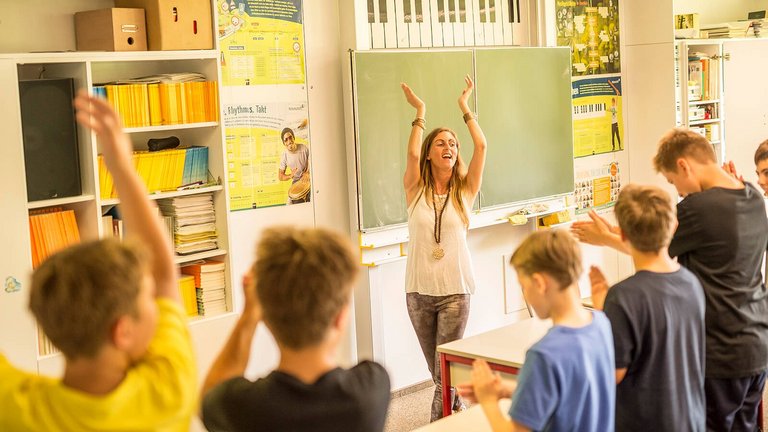
A quick stretch, coordinated cross-over movements, running through the classroom to various learning stations... What are the real benefits of movement impulses in the classroom and does learning through movement actually help pupils in concrete terms? Clear answer: YES! Researchers have been able to prove the positive effect of sport and movement on cognitive performance in numerous studies - even with short, moderate movement units.
More exercise - more performance
One thing is certain: the time students spend doing sport or exercising is more than well invested. Exercise not only stimulates the metabolism, but also provides the brain with more sensory stimuli to link content - which can be better stored and recalled during learning. Above all, however, physical activity stimulates the cardiovascular system, which means that the brain is better supplied with oxygen and cognitive performance is increased. The link between motor skills and cognition is now undisputed in terms of developmental and learning psychology. What's more, researchers have even been able to prove the positive effect of exercise on brain development.
Findings that should be put to urgent use in view of the increasing amount of time our children spend at school. The latest children and youth sports report also complains that the expansion of all-day schools and tight G8 timetables and learning plans in many federal states mean that sufficient exercise is less and less guaranteed in everyday life.
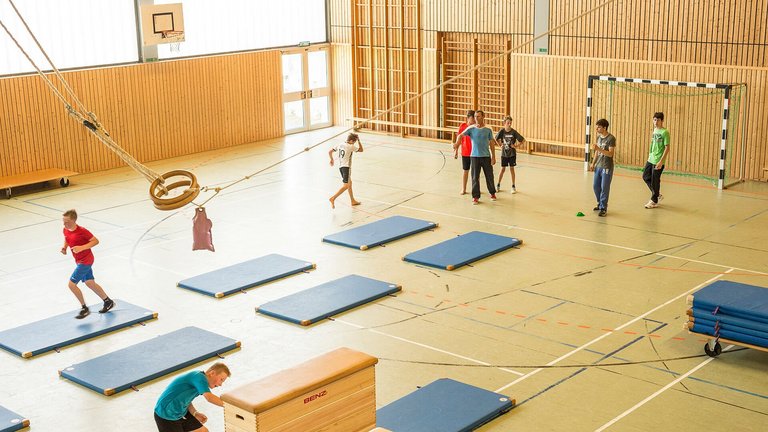
This makes it all the more important to bring more exercise into schools and not treat (compulsory) PE lessons as a side issue. "It goes without saying that a few hours of PE lessons a week are not enough to get pupils enough exercise," says PE teacher Martin Probst-Kaiser from Schloss-Schule Kirchberg. This is where movement breaks come into play to increase academic performance. In other words, small bursts of movement or coordination exercises that help to refresh pupils' minds when they lose concentration and performance - from the 5th lesson at the latest.
Small impulse examples with a big impact
As movement to accompany learning in the classroom, teachers can, for example, use running dictation or running vocabulary, station learning or project work to encourage pupils to absorb knowledge through movement. Learning through movement, i.e. grasping a topic through an action of movement, also activates tired classes - for example in the form of physical experiments such as balance tests by pupils on quickly constructed wooden seesaws or tests of strength in rope pulling.
Even small coordination exercises, such as alternating right hand to left heel or left hand to right ear and vice versa, bring great efficiency with little effort. It is also possible to relax for a few minutes in complete silence, during which the pupils listen to sounds outside the window, which is briefly opened to let in fresh air.
All of these options not only improve performance, but have also been proven to improve the efficiency and sustainability of learning: stimulating the brain through movement promotes the consolidation of brain structures and connections. In other words, knowledge can be better grasped, anchored and linked.
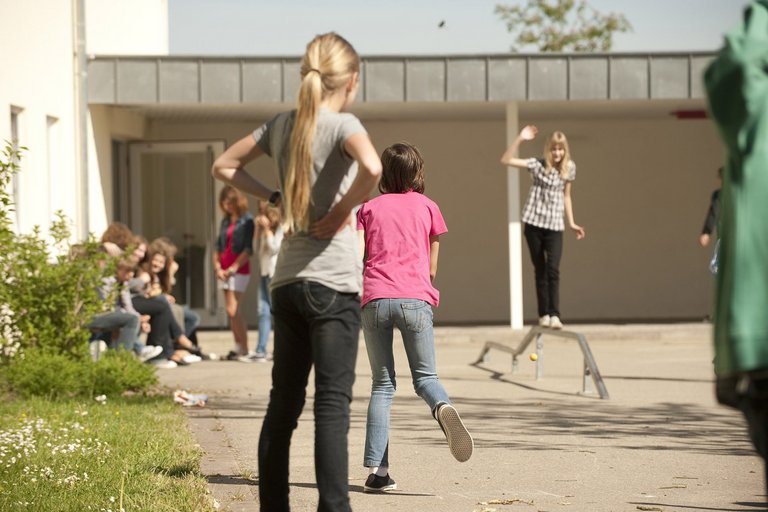
Outside the classroom, it is also worth taking a look at the school playground, which should motivate children to get moving: In addition to climbing frames or walls in the playground, painted bouncy boxes and target throwing areas, small equipment such as rugby balls or frisbees can also invite older pupils to get more exercise during breaks.
School and sport harmoniously combined
Of course, children should also be encouraged to do more exercise after school. But in the end, the problem remains that pupils often don't have the time to do sport. Studies estimate that children and young people sometimes spend 40 hours a week studying in or for school - sometimes because their parents are too ambitious in the machinery of a meritocracy. This makes it all the more important for schools and teachers to accept their responsibility to get their pupils more exercise.
"As a boarding school, our focus is therefore on bringing school and sport together in the best possible way for the children," explains sports teacher Martin Probst-Kaiser from the Schloss-Schule. In addition to numerous leisure activities and up to 30 extracurricular activities, the school cooperates with the Crailsheim Merlins basketball team and has an ambitious tournament rider in its own ranks in boarding school director Melanie Wies. To promote young talent, the children's training and sports schedules are individually coordinated with their respective timetables and study times. "Because, as we all know, a healthy mind lives in a healthy body - and in addition to a healthy diet, it also needs plenty of exercise," says Martin Probst-Kaiser.