How long does it take, what are the requirements, and why does “state recognition” make such a difference?
We’ve got the answers.
Many young people don’t realize until toward the end of their Realschule years just how much potential they have and what career path they actually want to pursue. It is precisely for these students that our Schloss-Schule Kirchberg offers our state-recognized Aufbaugymnasium program. Starting with Grade 10+, our Aufbaugymnasium program leads to the Abitur after completing Realschule.
In the following article, we’ll show you exactly what this path looks like at our school, what matters for admission, and why you should pay attention to the difference between “state-approved” and “state-recognized” when considering private schools.
Key Points at a Glance: Our Path at the Schloss-Schule Kirchberg from the Mittlere Reife to the General University Entrance Qualification (Abitur)
- With the Mittlere Reife, the path to the Abitur takes three years at our school: one year in Grade 10+, followed by two years in the upper division.
- Students can also earn the Fachhochschulreife at our school.
- Our upper-level high school is state-recognized. The Abitur diploma is therefore equivalent to that of a public high school, and we administer the exams ourselves.
- Students can begin studying a second foreign language with us in Grade 10+.
- Students who wish to join our boarding school earlier first attend our local partner Realschule and then transfer directly to Grade 10+ at our Aufbaugymnasium after earning the Mittlere Reife.
High School Diploma After the Realschulabschluss: How Long Does It Take?
Here at Schloss-Schule Kirchberg, the answer to this question is: Realschulabschluss plus three years. The first year is Grade 10+. Here, we bring all students up to the same level, fill in any gaps, and build a foundation for high school-level study in the core subjects. This is followed by two years of upper-level courses, culminating in the Abitur exam.
By the way, Grade 10+ is not a “repeat year.” Anyone transferring to a gymnasium with a Mittlere Reife generally needs three years to complete the Abitur in Baden-Württemberg. Grade 10+ is therefore the standard entry-level class.
In addition to the Abitur, students can also earn the Fachhochschulreife at our school. Which diploma and which path are suitable for your child depends on their previous educational background and academic performance. We would be happy to advise you personally on this matter.
High School Graduation at a Private School? What Parents Should Keep in Mind
Parents interested in a private boarding school like ours often ask us this question—and it’s a valid one. After all, not all private schools are the same. The key factor is whether the private school is state-approved or state-recognized for the specific educational program (such as an “Aufbaugymnasium”). Although the two terms sound similar, they are quite different:
- “State-approved” means the school is authorized to provide instruction as an alternative to a public school. However, its students typically take the final exam as an external exam at another institution - that is, before external examiners.
- State-recognized means: The school is permitted to provide instruction and, in addition, to administer its own exams and issue report cards that are just as valid as those from a public school. The examiners are therefore generally known!
In Baden-Württemberg, this is governed by the Private Schools Act. According to Section 10(4), a school is only granted the right to administer exams in accordance with the regulations for public schools and to issue diplomas once it has received state recognition. The Stuttgart Regional Council explains this in its FAQs on private schools. The state’s service portal explicitly mentions the right to issue diplomas such as the Abitur on its own.
| Government-approved | State-recognized | |
| Classes as an Alternative to Public School |
yes |
yes |
| Final Exam at One's Own School | No, usually an external audit | Yes, according to the rules for public schools |
| A diploma equivalent to that of a public school | not automatically |
yes |
What this means for your child at our Schloss-Schule Kirchberg
Our upper-level high school is state-accredited. The Abitur exam is administered at the Schloss-Schule in accordance with the regulations in effect for public high schools. The Abitur diploma is equivalent to that of a public high school. This means your child generally has the same access to college programs; of course, the respective admission procedures apply for programs with limited enrollment.
Our tip for your search for a private school or boarding school: State recognition always applies to a specific type of school. (At our school, this includes the Aufbaugymnasium, among others.) Therefore, be sure to ask every private school whether the specific educational program your child plans to attend is state-recognized.
What grades are required to transfer to our advanced high school program?
Simply put, your child needs an average grade of at least 3.0 in German, math, and English on their final report card. There must be no grades of 5 or 6. However, depending on the circumstances, the school administration may decide to administer an entrance exam. We’ve compiled all the details in the admission requirements for our Aufbaugymnasium.
For us, however, these grades are only part of the bigger picture. It’s just as important that a student truly wants to earn the Abitur. That’s why we always get to know each applicant personally as part of our admissions process.
No Second Foreign Language in Realschule: Does It Still Work?
Some Realschule students have only studied English up to that point in their school careers. At our school, however, this is not an obstacle to earning the General University Entrance Qualification. In grade 10+, your child can start learning French as a second foreign language through the so-called “French catch-up course.” This allows them to acquire the language skills required for the General University Entrance Qualification.
Will my child succeed in high school? Here’s how we support the transition…
It’s completely normal to feel a little daunted by the new pace. We take this seriously and have tailored our 10+ class and our overall support for students specifically to address this:
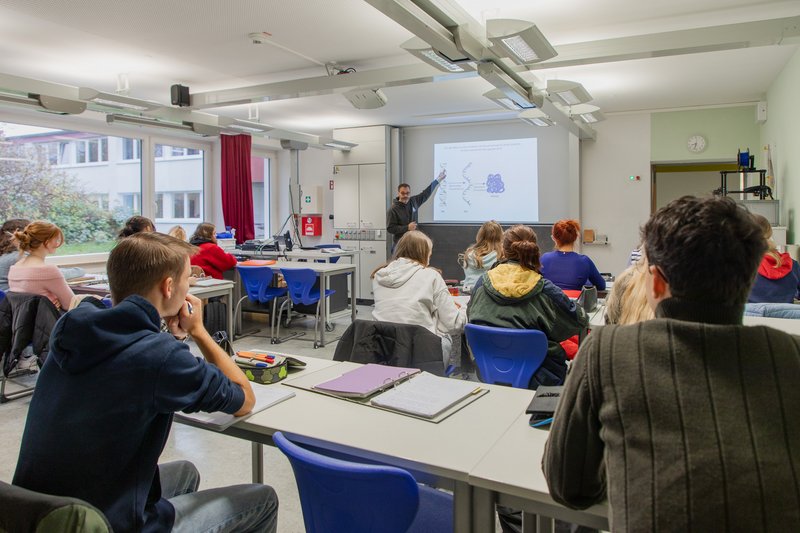
- Small classes: With an average of about 17 students per class, our teachers quickly notice when someone needs support.
- Targeted review: We revisit key concepts from middle school before delving deeper into the material.
- Independent learning: Our students learn to plan their assignments, make the most of study time, and reflect on their learning habits.
- Individual support through our specialized programs for students with high potential or those needing extra help, should they ever struggle with a subject.
- Support through the exam: Our upper-level counseling team assists with subject selection. Before the Abitur, an annual intensive week provides targeted preparation for the exam subjects.
Students who live at our boarding school have an additional advantage, especially during the transition phase: a reliable daily routine with supervised study periods and support from educational professionals who are available to help when things get difficult.
This structure provides many young people with a sense of security, especially during the first year after changing schools. Our sample class schedules, by the way, show exactly what a school week in the 10+ program looks like.
Want to join our boarding school while still in middle school? It’s possible!
Some families realize early on that their child would benefit from life and learning at a boarding school, even if our traditional boarding high school might not be the right fit (just yet). But we have a solution for that, too:
For many years, we’ve worked closely with the neighboring August-Ludwig-Schlözer School in Kirchberg and the Hermann-Merz School in Ilshofen, which our boarding students can attend.
As a boarding student, your child will attend our local partner school in the mornings. The rest of the day, they’ll live, learn, and spend time with us: with homework assistance, personal advisors, and all the recreational activities our boarding school offers, from horseback riding to basketball. This opens up three paths:
- Your child earns their Realschule diploma at the partner Realschule.
- (Or:) If the requirements are met, they can transfer to our Gymnasium earlier.
- (Or:) After earning their Mittlere Reife, they move directly into our 10+ class and from there continue on to the Abitur or the Fachhochschulreife.
What makes this special is that the transition to high school is much easier when the environment is already familiar. Friends, support networks, and daily routines remain the same—only the school is new. And because we maintain close communication with our partner schools, we know each student’s strengths well and can work with you to determine when the time is right for the next step.
You can find more information on our summary page “Boarding School with Realschule Program.”
Frequently Asked Questions from Parents About the Abitur After Realschule
Is the Abitur from the Schloss-Schule Kirchberg equivalent to that of a public high school? Yes. Our high school is state-recognized. Classes and exams follow the same regulations as at public high schools—and the Abitur diploma is completely equivalent.
Can my child transfer to the boarding school after earning the Mittlere Reife? Yes. With the Mittlere Reife or a comparable diploma, students can enter Grade 10+, even if they come from a Werkrealschule or another federal state.
Is it possible to attend the Aufbaugymnasium without boarding? Yes. We warmly welcome students from the region as day students.
How much does it cost to earn the Abitur at Schloss-Schule? You’ll find a transparent overview on our fees page. We’d be happy to advise you personally on possible partial scholarships.
When should we contact Schloss-Schule Kirchberg before a potential transfer? It’s best to do so early on, so there’s enough time for counseling and a (highly recommended) visit during the open house days or for a trial stay.
Get to know us: Your next step toward your child’s high school diploma
The best way to determine whether our Class 10+ program is the right fit for your child is to discuss it together—either in a personal conversation or during a visit to Kirchberg.
Get started with your child today:
- Browse through all the information about the 10+ program and our advanced high school track on our dedicated page together with your child, or request specific materials there
- And/or request the general digital information materials about our Schloss-Schule Kirchberg
- And/or schedule a personal consultation now
Or simply give us a call: You can reach our Admissions Office during regular business hours at +49 7954 9802-47. We’re happy to answer any questions you may have about the path from the Mittlere Reife to the Abitur. We look forward to hearing from you!
Related News:
- Student Interview: A Conversation with Petra from Slovakia– Petra talks about her time in the 10+ class and life at boarding school.
- Changing Schools: Why Boarding Schools Are Worth Considering– explores the decision to change schools and the parents’ perspective.
- Boarding School and School: Here Are the Six Most Frequently Asked Questions!– Answers typical questions from families about the relationship between school and boarding school.
- High School Boarding School: For the Best Possible High School Diploma for Each Student!– Expands on the topic of “individualized support on the path to graduation.”